35% of product research now starts with AI search — and growing fast among Gen Z and Millennials. When ChatGPT recommends "the best running shoes for flat feet" or Google AI answers "best budget espresso machine," your product needs to be cited.

E-commerce AI Search Optimization is the process of making your products the recommended answer when shoppers use AI search engines — ChatGPT, Google AI Overviews, Perplexity, and Gemini — to research products, compare options, and make purchasing decisions. With 35% of product research starting with AI search and growing rapidly, e-commerce brands not optimized for AI citations lose early consideration to competitors. Our e-commerce Answer Engine Optimization strategy combines comprehensive Product schema with specifications/availability/reviews, buying guides answering "best [product] for [use case]" queries, comparison content for "X vs Y" searches, and aggregated customer reviews with Review schema to make AI Answer engines confidently recommend your products.
Gen Z and Millennials increasingly ask ChatGPT or Perplexity "What's the best [product] for [use case]?" instead of scrolling through Google results. If your product isn't in the AI answer, you're invisible to the fastest-growing buyer segment.
Google AI Overviews now answer "best [product]" queries with specific product recommendations and cited sources. The brand cited first captures the click — not the one ranked #1 below the AI answer box.
When ChatGPT recommends your product by name, it carries implicit AI-attributed trust. Shoppers treat it as a personalized recommendation — converting at 2-4x the rate of traditional organic listings.
Implement comprehensive Product schema with specifications, pricing, availability, reviews, and comparison attributes. This is the structured language AI Answer engines read to decide which products to recommend.
Create "best [product] for [use case]" guides answering the exact shopping queries AI Answer engines receive. Structured with direct-answer blocks, comparison tables, and expert picks AI loves to cite.
Build "X vs Y" comparison pages for product alternatives and competitive shopping queries. AI Answer engines love structured, unbiased comparisons — and they cite the source that provides them.
Aggregate customer reviews with proper Review schema so AI Answer engines see verified social proof. High review counts and star ratings are trust signals AI weighs heavily in product recommendations.
Optimize category and collection pages with ItemList schema, faceted navigation, and category-level content that positions your brand as the authority in each product vertical.
Track which products AI Answer engines recommend, monitor competitor citations, and attribute revenue from AI-referred traffic to measure true ROI from e-commerce AEO.
High Purchase Intent — When someone asks "best [product] for [use case]" they're ready to buy. AI-referred shoppers convert 2-4x higher than organic search visitors
Volume + Frequency — Product queries are the highest-volume AI search category. Unlike B2B, shoppers return repeatedly for different product needs
Reduced CAC — AI citations are organic — no cost per click. Replace $5-50 CPC product ads with permanent AI recommendations
Category Ownership — Be the default AI recommendation in your product category and competitors can't bid above you
Product schema is structured data that tells AI Answer engines exactly what your product is, its specifications, pricing, availability, and reviews in a machine-readable format. When ChatGPT or Google AI needs to recommend "the best [product] for [use case]," it pulls from sources with structured Product data — name, description, price, review count, star rating, availability. Without this schema, AI Answer engines have to guess what your product does from unstructured page text, making them less likely to cite you.
Yes, our e-commerce Answer Engine Optimization strategy works across all platforms — Shopify, WooCommerce, Magento, BigCommerce, and custom-built stores. Each platform has different schema implementation methods, and we customize our approach accordingly. Shopify stores benefit from app-based schema injection, WooCommerce uses plugin-based structured data, and custom stores get direct code-level implementation.
Product schema optimizations typically show results within 2-4 weeks as AI Answer engines re-crawl your structured data. Buying guide and comparison content takes 30-60 days to build authority and begin appearing in AI recommendations. Full e-commerce Answer Engine Optimization programs see measurable traffic and revenue increases within 60-90 days, with compounding returns as more product categories are optimized.
E-commerce brands typically see 80-160% increases in organic traffic and 2-4x higher conversion rates from AI-referred visitors. Unlike paid ads with ongoing CPC costs, AI citations are organic — once your product is the AI-recommended answer, each referral costs $0. For brands spending $10K-$50K/month on product ads, Answer Engine Optimization often delivers equivalent traffic at a fraction of the cost. Start with a free AI audit to see your current product visibility.
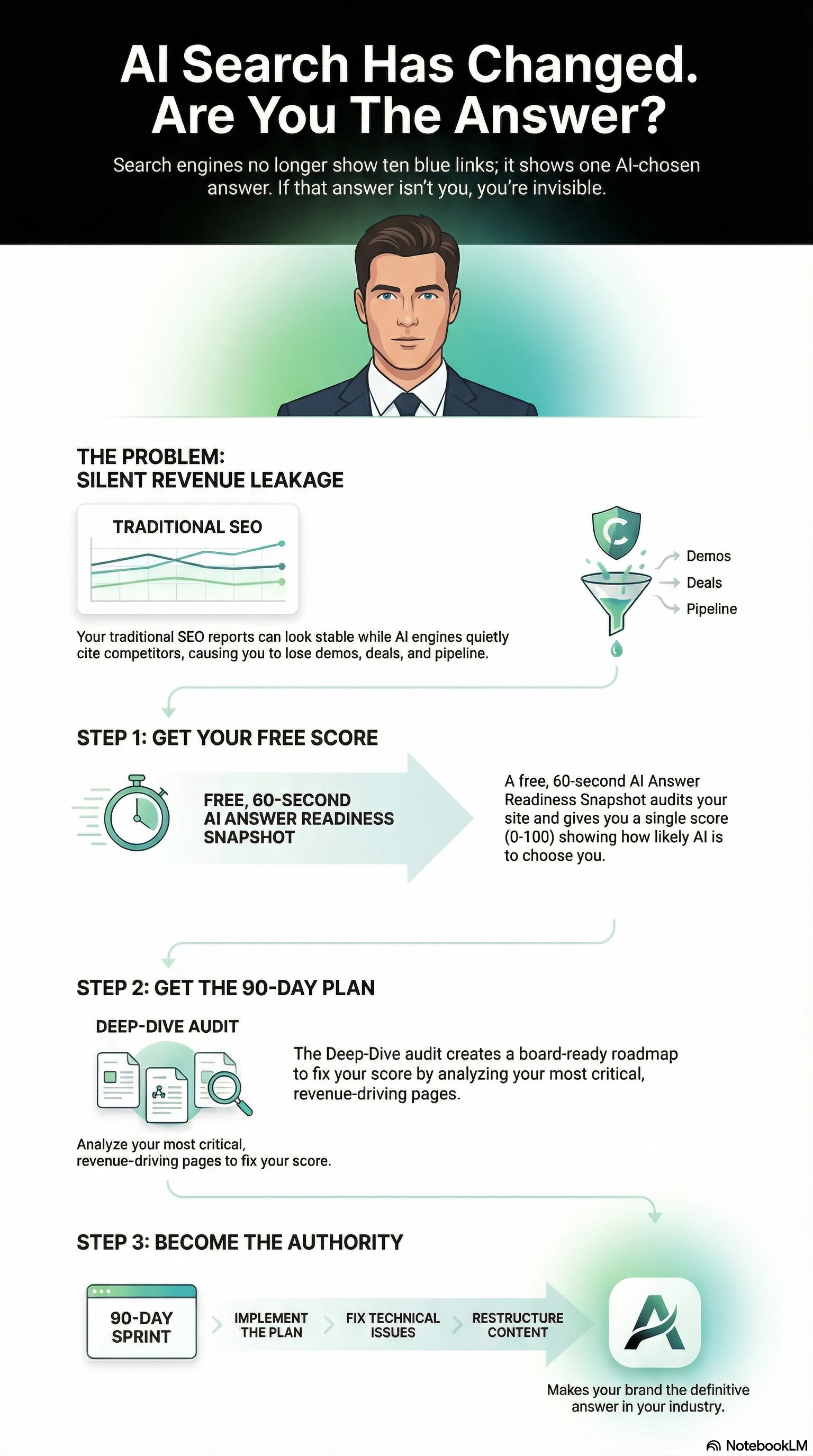
Get your free AI Product Visibility Score in 60 seconds. See how AI search engines view your products today.
Here's what drives businesses to partner with us for their AI visibility strategy.
Businesses work with AI Search Rankings because they want to be found when people ask AI Answer search engines for recommendations.
They want their business website to optimized for search engines and Answer Engines, so its easier to understand across Google search, Google Maps ChatGPT, Gemini, Perplexity, and Google AI results.
They want to reach potential customers earlier in the decision-making process.
They want more qualified inquiries from people who are already searching for the services they offer.
They want a clearer strategy for staying visible as search continues to change.
They want their website, content, and brand signals to work together more effectively.
They want to strengthen trust, improve visibility, and create more opportunities for growth.