
Most websites have schema. Very few have a schema that works.
Disconnected blocks prove nothing.
Your developer probably added schema code years ago. It passes the validator and it is doing almost nothing, because each block sits alone with nothing linking it to the others. A machine reading it learns four separate facts and no relationship between them.
What you get: Machines can follow the connection between your company, your services, your locations, and your people, which is what turns scattered facts into a business worth recommending.
- One connected graph
- Stable identifiers
- Matched to your pages
- Rechecked on change
Transparent monthly packages from $799 to $3,500 per month. No free audit to sit through, and no discovery call before you can see a price. Responds within 24 hours during Monday to Friday, 9am to 6pm Pacific Time.
What is schema engineering, and how is it different from adding schema?
Schema is code in your page that states your business facts in a form machines read directly, instead of guessing from your sentences. Adding schema usually means dropping a business block on the home page and a question block on a service page, with nothing joining them. Schema engineering means designing it as one connected set: every part gets a permanent identifier and points at the others, so a machine can follow the chain. This company provides this service, in these areas, described on this page, written by this person.
That difference matters because a recommendation needs confidence, and confidence comes from connected facts rather than isolated statements. This is included in every package from $799 to $3,500 a month, with the depth of the connections increasing at each level.
Every figure on this page comes from our published brand facts, so it says the same thing everywhere you find us.
Code is the one signal every tool reads directly.
ChatGPT, Google AI Overviews, Google AI Mode, Perplexity, Microsoft Copilot and Grok
Your sentences have to be interpreted. Your code gets read exactly as written. That makes it the highest value technical work available to you.
-
 ChatGPT
-
 Google AI Overviews
-
 Google AI Mode
-
 Perplexity
-
 Microsoft Copilot
-
 Grok
Grok
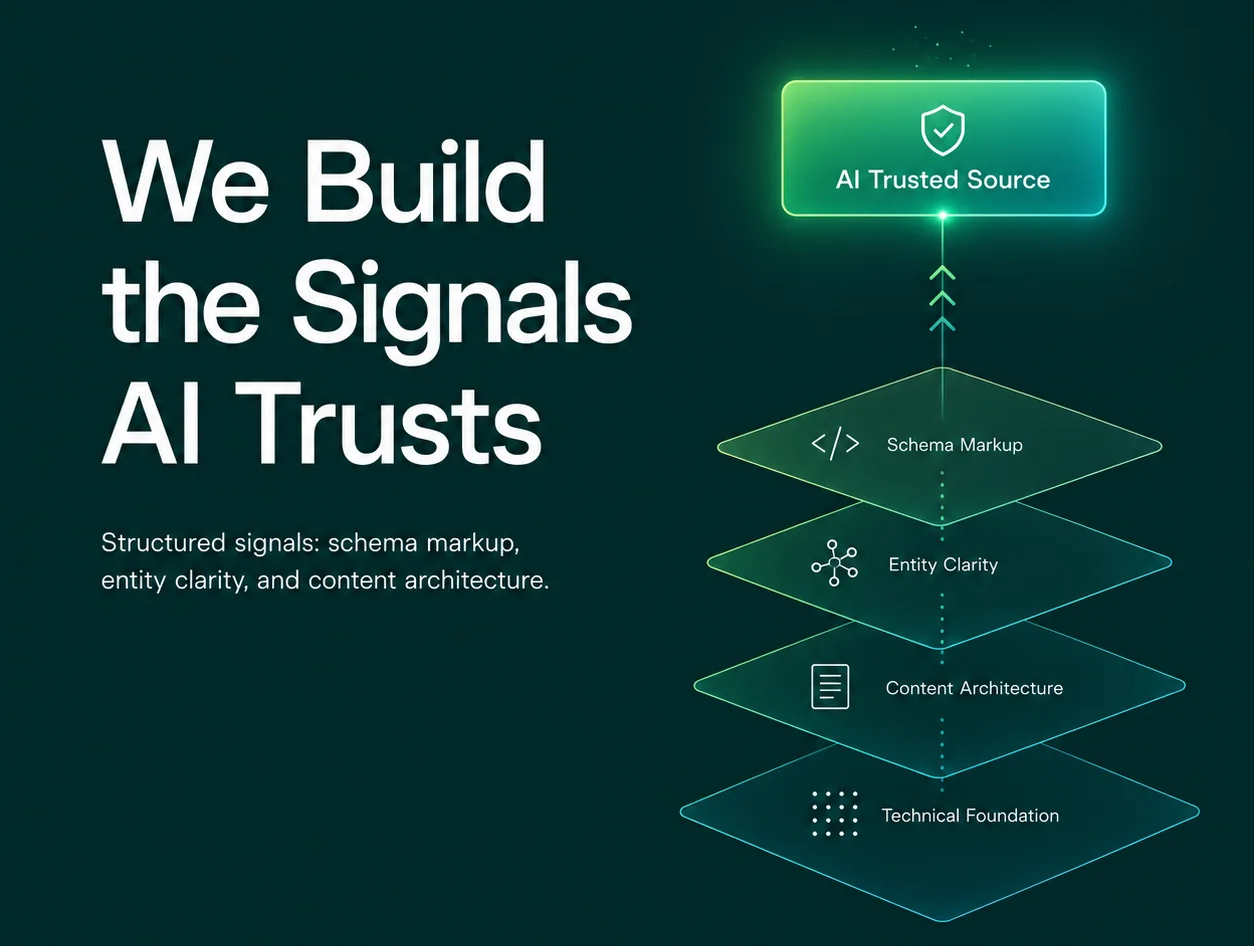
Your code passes the validator, and it is still not helping.
Passing a validator only proves the code is written legally. It says nothing about whether it is connected, accurate, or useful. Here is what we find on nearly every website we check.
-
Nothing points at anything else
A company block on one page and a service block on another with no shared identifier tells a machine nothing about how the two are related.
-
The code describes a business you no longer are
Written at launch and never revisited, it still lists services you dropped and an address you left. Code that contradicts your page is worse than no code.
-
The same identifier on every page
A template that repeats one identifier everywhere creates several conflicting definitions of one business, which cancels out the value of all of them.
-
It claims things your page never says
Ratings, review counts, or answers that exist only in the code are a guidelines violation, not a shortcut. They put your whole website at risk.
How the connected version actually gets built.
Built and maintained monthly, with the depth of connections growing at each package level.
A map before a single line is written
A written plan of every part of your business, its permanent identifier, and how it relates to the others, agreed before any code is added.
Entity workOne connected block per page
A single joined up piece of code per page, where every part points at your site wide company, website, and author identifiers by name.
Checked against your visible page
Every property compared to what a visitor can actually read before it ships, so nothing is claimed in code that is not on the page.
Rechecked whenever the page changes
When we improve a page, we recheck its code in the same pass. That is what stops the slow drift that makes most schema useless within a year.
Schema markupSchema engineering is one of six pillars, not a standalone tactic.
Buying a single tactic rarely moves visibility, because answer engines read the whole picture. Every package works all six pillars together at the level your tier defines.
-
Google + Google Maps Visibility
Advanced Google Business Profile, Google Maps, and local pack support across every priority service area, location, and competitor gap.
-
Google AI Overview + AI Answer Readiness
Track 150-250 local prompts, monitor AI answer accuracy, and structure pages so AI-generated answers describe your business correctly.
-
Website SEO Optimization
Optimize 5-8 pages and publish 2 new local content assets each month with advanced on-page and topical SEO.
-
Local Entity Authority
Map and strengthen business, service, location, and owner/founder entities into one connected local authority graph.
-
Reviews + Trust Signals
Run a reputation-growth strategy with reviews, proof placement, and legitimate local authority and PR opportunities.
-
Conversion + Lead Path Optimization
Optimize the full lead path across calls, forms, and booking links, with priority implementation and executive reporting.
A lot can go wrong with schema engineering. We check every one of these.
Schema code is invisible to you and read directly by machines, which makes it the easiest thing on your website to get wrong without ever finding out. Here is what actually goes wrong.
-
What usually goes wrong
Fake ratings get added and your whole site gets penalized
An agency adds star ratings for reviews you never collected because it looks good in search results. When Google notices, the penalty hits every page you own, not just that one.
How we make sure it is right
We refuse to publish proof you do not have
Review and rating code only goes on pages where real reviews are visible. If you ask us to fake it, we will say no and explain the risk you are asking us to take with your website.
-
What usually goes wrong
Three plugins each write their own version
Your theme, an SEO plugin, and a tag manager all add code. Now one page states three different versions of your business and machines trust none of them.
How we make sure it is right
We find every source and leave one
We track down everything adding code to your pages, remove the conflicting ones, and leave a single authoritative version per page.
-
What usually goes wrong
It gets built once and quietly rots
Code added as a one time project stops matching your pages within months. Nothing breaks visibly, so nobody notices until the value is long gone.
How we make sure it is right
It gets rechecked as part of the monthly work
Every time a page is improved, its code is revalidated in the same pass. A redesign becomes a scheduled recheck rather than a discovery six months later.
-
What usually goes wrong
Code gets added to a page with nothing to describe
Schema goes onto thin pages that say very little. There is nothing real to describe, so it adds no value and sometimes highlights how thin the page is.
How we make sure it is right
We fix the page first, then describe it
If a page has nothing worth stating, we tell you the content comes first. We will not bill you for describing an empty page.
This is the whole reason to hire someone. You cannot see this code and you cannot easily tell whether it is right. That is precisely why it needs to be done by someone who checks rather than someone who installs a plugin.
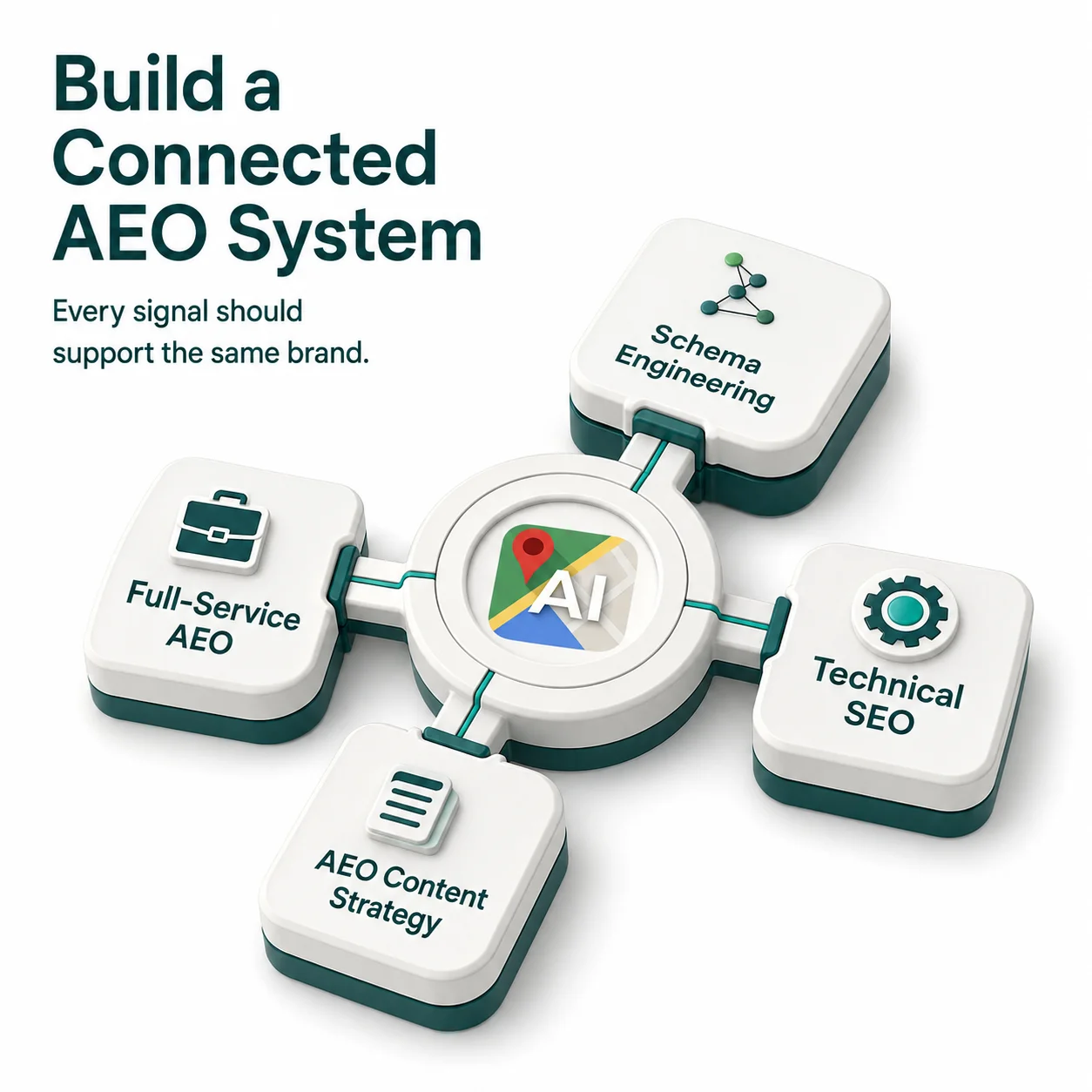
Six stages, and what each one produces for Schema engineering.
Every engagement runs on the same method, so you always know which stage you are in, what it is producing, and what comes next. The stages are Find, Fix, Structure, Prove, Track, and Grow.
-
Find
Stage 1. Find
Establish what buyers actually ask and where you stand today.
You get a full audit of your existing code, showing what is valid, what has drifted, and what is disconnected.
-
Fix
Stage 2. Fix
Remove the technical and factual blockers that stop a machine reading you correctly.
You get duplicate identifiers, contradictions, and unsupported claims removed.
-
Structure
Stage 3. Structure
Rebuild the page and its data so an answer engine can lift a correct answer.
You get one connected set of code with permanent identifiers and real relationships.
-
Prove
Stage 4. Prove
Attach the evidence a buyer and a model both need before recommending you.
You get author, company, and review code added only where your page genuinely supports it.
-
Track
Stage 5. Track
Measure the prompts, the competitors, and the movement every month.
You get monthly validation reporting, including any drift caused by content changes.
-
Grow
Stage 6. Grow
Expand coverage into the next set of questions, services, and locations.
You get the connections extended as you publish new services, locations, and content.
Two results we can show you, with their limits stated.
We publish the evidence label and the limitation next to every number, because a result without its scope is a claim, not proof. We do not guarantee AI rankings or citations, because third parties control those systems.
Toolsforhuman.com
AI Search Rankings used schema-first Answer Engine Optimization, layered JSON-LD, robust canonicals, and multilingual hreflang to help Toolsforhuman.com earn 26,300 Microsoft Copilot citations across 160 plus pages, including Spanish-language pages, in a sample window of about three months.
Measured on Microsoft Copilot. The result applies to the documented sample window and does not guarantee future citations.
Read the Toolsforhuman.com case studyLaser Tagging Inc.
AI Search Rankings rebuilt the Laser Tagging Inc. digital brand and website, expanded its service-area relevance across Newark, Fremont, San Jose, and nearby Bay Area communities, and documented 4,460 client-reported Google generative AI impressions in the selected last-three-month window.
Measured on Google AI Overviews and AI Mode. The report measures Google generative AI impressions. It does not prove a ChatGPT recommendation, a click, a booking, a lead, or revenue.
Read the Laser Tagging Inc. case study
The four questions serious buyers ask before they sign.
Each answer sits next to the doubt that prompts it, with the evidence we can actually stand behind.
Our developer already added schema. Is this duplicate work?
We check what exists first, and we keep whatever works.
The first pass is an audit of what you already have. Where blocks are correct and connected, they stay. What we nearly always find is that the blocks are individually valid and collectively useless, because nothing points at anything else and several no longer match the page. Repairing that is different work from adding more.
The fit review lists exactly which of your existing blocks are correct, which have drifted, and which are disconnected.
Does this code actually change anything?
It is the only part of your page read exactly as written.
Everything else on your page has to be interpreted from language, which means guessing, which means doubt. Code is read directly. That is why it is the highest value technical work available, and why our clearest documented result came from a code first rebuild rather than a content campaign.
Real result: a code first rebuild helped Toolsforhuman.com earn 26,300 Microsoft Copilot citations across more than 160 pages in about three months.
Can we just add ratings to get stars in Google?
No, and we will refuse to do it.
Code has to describe what is visible on the page. Adding ratings you have not collected, review counts you cannot prove, or answers that do not appear in your content breaks the guidelines, risks a penalty across your whole website, and is dishonest. We add review code only where real reviews are shown.
Our published rules prohibit fake ratings, review counts, awards, and testimonials in content and in code.
Will this break when we redesign the site?
It will drift, which is why it is monthly rather than a project.
Any content change can break the match between your code and your page. Buying this as a one time project guarantees decay, usually within a year. Including it monthly means it gets rechecked whenever a page changes, and a redesign becomes a planned recheck.
Rechecking on change is included at every package level, not only the top one.
Answer five questions and see which package fits.
This runs entirely in your browser using the published package scope. Nothing is sent anywhere, nothing is stored, and you do not have to give an email address to see the answer.
Answer all five questions above and the recommendation will appear here, along with the reason behind it.
Schema engineering is delivered inside one of three monthly packages.
Local small businesses
Local AI Answer Starter
Help nearby customers find, trust, and choose your business across Google, Google Maps, and AI answers.
$799per month
Build your local AI answer foundation
- Google Business Profile + Google Maps optimization (categories, services, areas, hours, photos)
- Get found in Google AI Overviews + AI answers when customers ask "who to hire"
- 25 high-intent local buyer prompts tracked every month
- Competitor AI visibility comparison against 3 local rivals
- 1 answer-first page optimized + 3-5 new local FAQs every month
- LocalBusiness, Service & FAQ schema + NAP citation cleanup
Growing local businesses
Local AI Answer Growth
Win more calls, bookings, and quote requests across Google, Google Maps, and AI answer engines.
$1,500per month
Turn local AI visibility into more calls
- Everything in Starter, expanded for faster local growth
- 50-75 buyer-intent prompts tracked across every major AI answer engine
- Competitor AI + SEO gap analysis against 5 local rivals
- 2-3 pages optimized + 1 new local content asset (city, service, or cost guide) monthly
- 5-10 new local FAQs + full on-page SEO (titles, meta, links, alt text)
- Local entity authority + schema (LocalBusiness, Service, FAQ, Review)
Competitive & multi-location businesses
Local AI Answer Authority
Build a complete local authority system across Google, Maps, AI answers, reviews, and content.
$3,500per month
Become the trusted local answer at scale
This is the entry package that includes Schema engineering.
- Everything in Growth, built for competitive and multi-location markets
- 150-250 local prompts tracked + 10 competitors monitored
- 5-8 pages optimized + 2 new local content assets every month
- 10-20 new local FAQs, definitions & direct-answer blocks monthly
- Complete local entity authority system (business, service, location, owner/founder + SameAs)
- Advanced schema + local authority & PR opportunity building
Not sure which one applies to you? Use the package fit finder above, or compare every line item on the full pricing page. Every package includes schema engineering at the level shown in the table below.
Exactly what Schema engineering covers at each package level.
This is the operational scope, written the way it appears in your monthly plan. Scroll the table sideways on a small screen.
| Included work | Local AI Answer Starter$799/mo | Local AI Answer Growth$1,500/mo | Local AI Answer Authority$3,500/mo |
|---|---|---|---|
| Business map and identifiers | Core business | Adds services and areas | Full map including founder and content |
| Types of code added | Business, company, service and FAQ | Adds reviews and linked services | Adds articles, people and ratings where real |
| Pages getting code monthly | 1 | 2 to 3 | 5 to 8 |
| Checking code matches the page | When first added | On every improvement | On every improvement plus scheduled audits |
| Multiple location handling | One main location | Several areas | Full multiple location map |
| Drift checking | Yearly review | Monthly | Monthly with leadership reporting |
Anything outside this scope is quoted separately and explained before the engagement starts, so there is never an invoice you did not expect.
Three situations where this engagement pays for itself.
If one of these describes your position, the fit review will be short and useful. If none of them do, say so and we will tell you honestly.
You have a big or template built site
Many pages built from one template is exactly where identifiers collide and drift happens, and exactly where connecting them properly pays off most.
You have several locations or brands
Multiple businesses that need telling apart from each other, and from similarly named competitors, need identifiers designed on purpose.
Nobody has ever checked your code
It was added once by somebody who has since moved on, and nobody has looked at whether it still matches your website.
When this is the wrong purchase
This is wrong for you if you cannot change your website templates, because this code has to be written by the site itself. Injecting it through a tag manager is a fallback we can use and it is measurably less reliable. We will tell you that before you buy, not afterwards.
Questions about schema engineering.
Each answer opens with the direct answer, so you can read one line and move on.
What is schema engineering?
It is designing the code behind your website as one connected set rather than isolated blocks. Every part gets a permanent identifier and points at the others, so a machine can follow the chain from your company to your services, locations, pages, and people.
How is that different from just adding schema markup?
Adding schema means placing valid blocks on individual pages. Engineering means designing the identifiers and relationships first so the blocks form one connected whole. Individually valid but disconnected blocks are the most common thing we find, and they achieve very little.
Can you add star ratings to our search listings?
Only where genuine reviews are shown on the page. Adding ratings you have not collected breaks search engine guidelines, risks a penalty across your whole website, and is dishonest. We will refuse that request and explain why.
Our developer already added schema. Do we need this?
We check first and keep whatever works. The usual finding is that blocks are individually valid but collectively useless because nothing points at anything else, and several have drifted from the page they describe. The review lists exactly which of yours fall into each category.
Will schema break when we change our content?
It can, which is why rechecking is included every month rather than sold as a one time project. When a page is improved, its code is rechecked in the same pass, and a redesign becomes a planned recheck.
How much does schema engineering cost?
It is included in all three packages at $799, $1,500, and $3,500 per month, with the depth increasing at each level. Websites with several locations or a lot of template built pages usually need $3,500 for a full connected map.
Tell us what your code currently claims.
We audit the code on your website, find the contradictions, and recommend the package that matches how much needs connecting.
- A written recommendation of which package fits, and why.
- The specific gaps we can see on your site before we speak.
- A clear statement of anything that falls outside package scope.
- Responds within 24 hours, Monday to Friday, 9am to 6pm Pacific Time.
- No obligation, no contract at this stage, and we never sell your details.
Three short steps
Request your Schema engineering fit review
We ask more than a typical form on purpose. The extra detail is what lets us answer with a real recommendation instead of a sales call.
Your request is in. Thank you.
A confirmation email is on its way, and Jagdeep Singh reviews these personally.
- Responds within 24 hours during Monday to Friday, 9am to 6pm Pacific Time.
- You will get a written package recommendation, not a sales deck.
- In a hurry? Call or text +1 (510) 399-5523.
Turn disconnected blocks into something that works.
The work and the price are above. The review includes a summary of what your current code is and is not doing for you.
Machines can follow the connection between your company, your services, your locations, and your people, which is what turns scattered facts into a business worth recommending.
- Published pricing, no discovery call required
- Evidence and limitations stated together
- Responds within 24 hours
Prefer to talk first? Call or text +1 (510) 399-5523 or email jd@aisearchrankings.com.