
A page a search engine cannot read cannot be recommended.
Foundations first.
The most expensive problems on a website make no noise at all. Pages quietly dropping out of Google. Content that never loads for a crawler. Nothing looks broken to you, which is exactly why it stays broken for years.
What you get: Search engines and AI Search Engines can actually reach, load, and understand your pages, which is the thing every other improvement depends on.
- Found and indexed
- Loads properly
- Fast on mobile
- Linked correctly
Transparent monthly packages from $799 to $3,500 per month. No free audit to sit through, and no discovery call before you can see a price. Responds within 24 hours during Monday to Friday, 9am to 6pm Pacific Time.

What is technical SEO, and why does it come first?
Technical SEO is the work of making sure search engines and AI Search Engines can reach your pages, load them properly, understand how they are organized, and add them to their index. It covers whether your pages can be found, whether your content appears without scripts running, whether the right page is marked as the main version, and whether your pages load quickly.
It comes first because everything else depends on it. A brilliantly written answer on a page nothing can reach contributes exactly zero. This matters more in AI search than it used to: a ranking system can still place a half understood page tenth, but a tool writing an answer will simply use a source it can read cleanly. Included in every package from $799 a month.
Every figure on this page comes from our published brand facts, so it says the same thing everywhere you find us.
Every tool has to fetch your page before it can use it.
ChatGPT, Google AI Overviews, Google AI Mode, Perplexity, Microsoft Copilot and Grok
This is the one requirement all of them share without exception, which is why it is never sold here as an optional extra.
-
 ChatGPT
-
 Google AI Overviews
-
 Google AI Mode
-
 Perplexity
-
 Microsoft Copilot
-
 Grok
Grok

The most expensive technical problems are completely silent.
Nothing breaks visibly when a page falls out of Google or fails to load for a crawler. Your website looks perfect to you. Here is what costs the most while staying invisible.
-
Your content needs scripts to exist
If your main content only appears after JavaScript runs, it may never be read. What matters has to be in the page as delivered.
-
The wrong page is marked as the main one
A misconfigured setting tells search engines to ignore the page you actually want ranking, and nothing on your website looks wrong while it happens.
-
Important pages have no links to them
A page nothing links to is reachable by a human with the address and effectively invisible to a crawler with no path to it.
-
Slow pages get visited less
Crawlers have a budget. Slow pages get fetched less often, which means your newest content is the slowest to get noticed.
What we fix, in order of what it costs you.
Diagnosed and fixed monthly, starting with whatever is currently costing you the most.
Getting found and indexed
Sitemaps, crawler instructions, redirect chains, and coverage errors sorted for Google and Bing, then confirmed page by page rather than assumed.
Making sure your content loads
Confirming your main content, headings, links, and code are all present in the page as delivered, rather than appearing only after scripts run.
Page speed on real connections
Load time, layout stability, and responsiveness improved through image, font, script, and caching work, tested on mobile rather than a fast desktop.
Build workCorrect linking and main page settings
The right page marked as the main version, a clear path to every important page, and link text that actually says where it goes.
Technical SEO is one of six pillars, not a standalone tactic.
Buying a single tactic rarely moves visibility, because answer engines read the whole picture. Every package works all six pillars together at the level your tier defines.
-
Google + Google Maps Visibility
Improve your Google Business Profile, categories, service areas, hours, and local listings so nearby customers can find you in Google and Google Maps.
-
Google AI Overview + AI Answer Readiness
Test 25 local "who to hire" prompts and structure clear, direct answers so Google AI Overviews and AI engines understand when to mention your business.
-
Website SEO Optimization
Clean up page titles, meta descriptions, and headings, and optimize one priority page each month so customers and search engines understand your services.
-
Local Entity Authority
Make your business name, services, and service area consistent across your website, Google profile, listings, and schema.
-
Reviews + Trust Signals
Monitor reviews and guide responses, then place real proof and trust signals where customers decide whether to call.
-
Conversion + Lead Path Optimization
Review phone, form, and quote paths on priority pages so more visitors turn into calls, bookings, and inquiries.
A lot can go wrong with technical seo. We check every one of these.
Technical work can break a working website faster than anything else on this list. Here is what goes wrong and what we do to make sure it does not happen to you.
-
What usually goes wrong
You get an audit instead of a fix
A two hundred row spreadsheet arrives with no priority order. Your team starts with the easy items, runs out of time, and the expensive problems stay untouched.
How we make sure it is right
We rank by cost and then fix it
We find the problems, sort them by what they are actually costing you, and either fix them or write the instruction precisely enough for your developer to act same day.
-
What usually goes wrong
A fix breaks something that was working
Redirects get changed, pages get merged, settings get updated. Traffic drops, and with no record of the starting point nobody can work out which change did it.
How we make sure it is right
We record everything before we touch it
Current positions, addresses, and index status get written down first. Rankings appear in every monthly report, so a problem is visible in weeks and traceable to one change.
-
What usually goes wrong
Only Google gets checked
Bing gets ignored entirely. Microsoft Copilot runs on Bing, so pages missing from that index cannot be cited by Copilot no matter how good they are.
How we make sure it is right
We confirm coverage on both
Google and Bing both get checked page by page. The Bing gaps are usually the cheapest and fastest wins in the entire engagement.
-
What usually goes wrong
Speed gets chased while the real problem is elsewhere
Months get spent shaving load times on a site whose actual problem is that half its pages are not indexed. The score improves and nothing else does.
How we make sure it is right
We check what is actually broken first
Speed is one of four things and rarely the one that is wrong. We confirm what is indexed and what loads before spending your money on performance.
This is the whole reason to hire someone. Everything else you buy sits on top of this. Getting it wrong quietly wastes every dollar spent on content and everything after it.
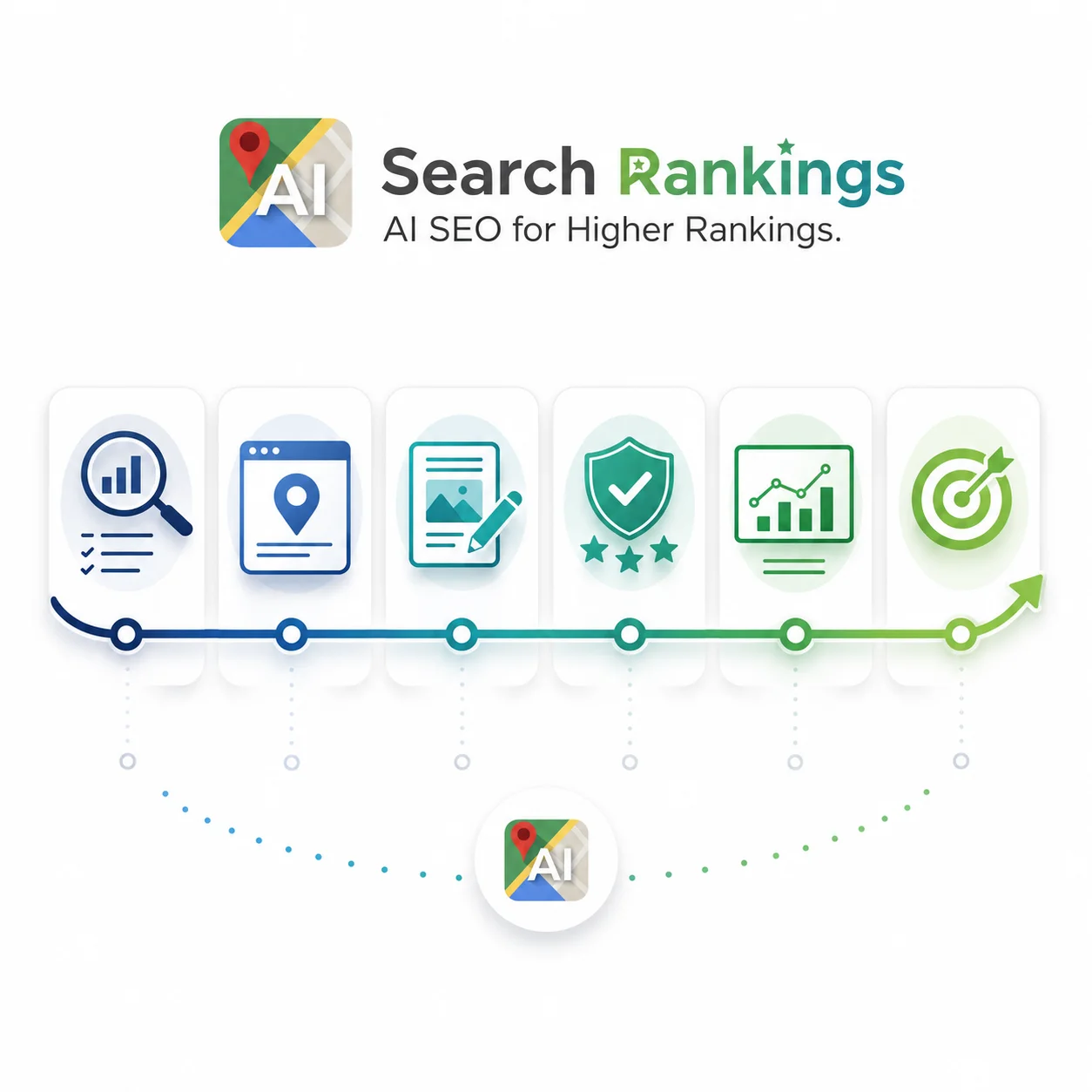
Six stages, and what each one produces for Technical SEO.
Every engagement runs on the same method, so you always know which stage you are in, what it is producing, and what comes next. The stages are Find, Fix, Structure, Prove, Track, and Grow.
-
Find
Stage 1. Find
Establish what buyers actually ask and where you stand today.
You get a confirmed picture of what is indexed, what is not, and what loads for a crawler today.
-
Fix
Stage 2. Fix
Remove the technical and factual blockers that stop a machine reading you correctly.
You get the most expensive problems fixed first, in order of what they cost you.
-
Structure
Stage 3. Structure
Rebuild the page and its data so an answer engine can lift a correct answer.
You get your content and code confirmed present in the page as delivered.
-
Prove
Stage 4. Prove
Attach the evidence a buyer and a model both need before recommending you.
You get linking and main page settings corrected so every important page has a clear path.
-
Track
Stage 5. Track
Measure the prompts, the competitors, and the movement every month.
You get monthly reporting of coverage, page speed, and what was fixed that month.
-
Grow
Stage 6. Grow
Expand coverage into the next set of questions, services, and locations.
You get ongoing checks so new problems are caught in the month they appear.
Two results we can show you, with their limits stated.
We publish the evidence label and the limitation next to every number, because a result without its scope is a claim, not proof. We do not guarantee AI rankings or citations, because third parties control those systems.
Toolsforhuman.com
AI Search Rankings used schema-first Answer Engine Optimization, layered JSON-LD, robust canonicals, and multilingual hreflang to help Toolsforhuman.com earn 26,300 Microsoft Copilot citations across 160 plus pages, including Spanish-language pages, in a sample window of about three months.
Measured on Microsoft Copilot. The result applies to the documented sample window and does not guarantee future citations.
Read the Toolsforhuman.com case studyLaser Tagging Inc.
AI Search Rankings rebuilt the Laser Tagging Inc. digital brand and website, expanded its service-area relevance across Newark, Fremont, San Jose, and nearby Bay Area communities, and documented 4,460 client-reported Google generative AI impressions in the selected last-three-month window.
Measured on Google AI Overviews and AI Mode. The report measures Google generative AI impressions. It does not prove a ChatGPT recommendation, a click, a booking, a lead, or revenue.
Read the Laser Tagging Inc. case study
The four questions serious buyers ask before they sign.
Each answer sits next to the doubt that prompts it, with the evidence we can actually stand behind.
We had an audit last year. We already have the list.
A list is not the work, and it is the part with no value.
Most businesses we talk to have a technical audit sitting in a folder, largely unimplemented, because a long unordered spreadsheet is genuinely hard to act on. We find the problems, order them by what they cost you, and then either fix them or specify them precisely enough for your developer.
The monthly report names what was fixed rather than what was found, so progress is measurable.
Our site is fast. Do we need this?
Speed is one of four things, and rarely the broken one.
A fast website can still have the wrong page marked as the main version, important pages missing from the index, content nothing links to, and main content that only exists after scripts run. Those are silent and considerably more expensive than a slow page. We check speed, and it is usually not where the problem is.
Index coverage is confirmed page by page rather than guessed from a performance score.
Will you break something while fixing things?
That is exactly why we record everything first.
Before we touch anything we write down current positions, addresses, and index status for the pages that earn you money. Any address change gets permanent forwarding, and rankings appear monthly so a problem shows up immediately rather than three months later. If something does move, we can trace which change came before it.
Positions and addresses are recorded before any change so movement can be traced to a specific cause.
Our developer says the site is fine.
It probably is fine as software. That is a different question.
A website can be well built and still be hard for a crawler to consume, because the requirements are different. Building pages in the browser, dynamic routing, and loading content on scroll are all reasonable engineering choices that cause search problems. We write findings as specific technical requirements a developer can act on, not complaints.
Findings are written as implementable technical specifications rather than general recommendations.
Answer five questions and see which package fits.
This runs entirely in your browser using the published package scope. Nothing is sent anywhere, nothing is stored, and you do not have to give an email address to see the answer.
Answer all five questions above and the recommendation will appear here, along with the reason behind it.
Technical SEO is delivered inside one of three monthly packages.
Local small businesses
Local AI Answer Starter
Help nearby customers find, trust, and choose your business across Google, Google Maps, and AI answers.
$799per month
Build your local AI answer foundation
This is the entry package that includes Technical SEO.
- Google Business Profile + Google Maps optimization (categories, services, areas, hours, photos)
- Get found in Google AI Overviews + AI answers when customers ask "who to hire"
- 25 high-intent local buyer prompts tracked every month
- Competitor AI visibility comparison against 3 local rivals
- 1 answer-first page optimized + 3-5 new local FAQs every month
- LocalBusiness, Service & FAQ schema + NAP citation cleanup
Growing local businesses
Local AI Answer Growth
Win more calls, bookings, and quote requests across Google, Google Maps, and AI answer engines.
$1,500per month
Turn local AI visibility into more calls
- Everything in Starter, expanded for faster local growth
- 50-75 buyer-intent prompts tracked across every major AI answer engine
- Competitor AI + SEO gap analysis against 5 local rivals
- 2-3 pages optimized + 1 new local content asset (city, service, or cost guide) monthly
- 5-10 new local FAQs + full on-page SEO (titles, meta, links, alt text)
- Local entity authority + schema (LocalBusiness, Service, FAQ, Review)
Competitive & multi-location businesses
Local AI Answer Authority
Build a complete local authority system across Google, Maps, AI answers, reviews, and content.
$3,500per month
Become the trusted local answer at scale
- Everything in Growth, built for competitive and multi-location markets
- 150-250 local prompts tracked + 10 competitors monitored
- 5-8 pages optimized + 2 new local content assets every month
- 10-20 new local FAQs, definitions & direct-answer blocks monthly
- Complete local entity authority system (business, service, location, owner/founder + SameAs)
- Advanced schema + local authority & PR opportunity building
Not sure which one applies to you? Use the package fit finder above, or compare every line item on the full pricing page. Every package includes technical seo at the level shown in the table below.
Exactly what Technical SEO covers at each package level.
This is the operational scope, written the way it appears in your monthly plan. Scroll the table sideways on a small screen.
| Included work | Local AI Answer Starter$799/mo | Local AI Answer Growth$1,500/mo | Local AI Answer Authority$3,500/mo |
|---|---|---|---|
| Index and crawl checks | Core pages, Google and Bing | Full website coverage review | Full coverage with ongoing checks |
| Checking content actually loads | Your best pages | Every page we improve | Site wide across all templates |
| Page speed work | Diagnosis and priority fixes | Ongoing improvement | Ongoing with priority help |
| Main page settings and redirects | Included | Included | Included with scheduled audits |
| Internal linking | Your best pages | Ongoing across improved pages | Site wide structure work |
| Who does the fixing | Written instructions | Instructions plus monthly call | We implement, with priority |
Anything outside this scope is quoted separately and explained before the engagement starts, so there is never an invoice you did not expect.
Three situations where this engagement pays for itself.
If one of these describes your position, the fit review will be short and useful. If none of them do, say so and we will tell you honestly.
You migrated or redesigned
A migration is the single most common cause of silently losing pages from Google, and it is usually found months later when the traffic is already gone.
Your site is built in the browser
Sites that build every page with JavaScript are where these problems concentrate. Confirming what a crawler actually receives is the first thing worth checking.
Your audit was never implemented
You have the findings and no way to act on them. Ordering and fixing is the missing half, and it is the half that produces the result.
When this is the wrong purchase
This is not the right first purchase if your technical foundation is already strong and confirmed, because you would be paying for a diagnosis that finds nothing. In that case content and identity work will produce more, and the review will tell you which situation you are in.
Questions about technical seo.
Each answer opens with the direct answer, so you can read one line and move on.
What is technical SEO?
It is the work of making sure search engines and AI Search Engines can reach your pages, load them, understand how they are organized, and index them. It covers being found and indexed, content that loads without scripts, correct main page settings, internal linking, and page speed.
Why does technical SEO matter more for AI search?
A ranking system can still place a half understood page in a list. A tool writing an answer will simply use a source it can read cleanly instead. That makes technical readability a pass or fail condition rather than a scoring factor.
We already have a technical audit. Do we need another?
Probably not another audit. Most businesses have findings sitting unimplemented because a long unordered list is hard to act on. We order by what each problem costs you and then fix it, or specify it precisely enough for your developer to act quickly.
Will fixing technical issues risk our current rankings?
We record current positions, addresses, and index status before changing anything, apply permanent forwarding to any address change, and report rankings monthly. That means a problem is visible immediately and traceable to the change that caused it.
Do you check Bing as well as Google?
Yes, and it is frequently neglected. Microsoft Copilot runs on the Bing index, so pages missing from Bing cannot be cited by Copilot at all. We confirm coverage on both, and the Bing gaps are often the cheapest wins available.
How much does technical SEO cost?
It is included in every package at $799, $1,500, or $3,500 per month. Larger websites and sites built in the browser usually need the middle or top package, because coverage checking scales with the number of templates.
Tell us what your website is built on.
We check what is actually indexed on Google and Bing, confirm what a crawler receives, and recommend the package that matches your website size.
- A written recommendation of which package fits, and why.
- The specific gaps we can see on your site before we speak.
- A clear statement of anything that falls outside package scope.
- Responds within 24 hours, Monday to Friday, 9am to 6pm Pacific Time.
- No obligation, no contract at this stage, and we never sell your details.
Three short steps
Request your Technical SEO fit review
We ask more than a typical form on purpose. The extra detail is what lets us answer with a real recommendation instead of a sales call.
Your request is in. Thank you.
A confirmation email is on its way, and Jagdeep Singh reviews these personally.
- Responds within 24 hours during Monday to Friday, 9am to 6pm Pacific Time.
- You will get a written package recommendation, not a sales deck.
- In a hurry? Call or text +1 (510) 399-5523.
Fix the foundation before building on it.
The work and the price are above. The review reports your actual index coverage on both Google and Bing so you know exactly where you stand.
Search engines and AI Search Engines can actually reach, load, and understand your pages, which is the thing every other improvement depends on.
- Published pricing, no discovery call required
- Evidence and limitations stated together
- Responds within 24 hours
Prefer to talk first? Call or text +1 (510) 399-5523 or email jd@aisearchrankings.com.