Key Takeaways
- AEO focuses on becoming the direct answer AI provides, moving beyond just ranking for keywords on search engine results pages.
- Traditional SEO optimizes for keyword matching and link authority, aiming for organic visibility on classic search engines.
- AI search requires content that is factual, authoritative, clearly structured, and directly answers user questions.
- Businesses must adapt by prioritizing semantic understanding, entity recognition, and helpful content to thrive in the AI search era.
Understanding the Shift
What is AEO and How Does it Differ from Traditional SEO?
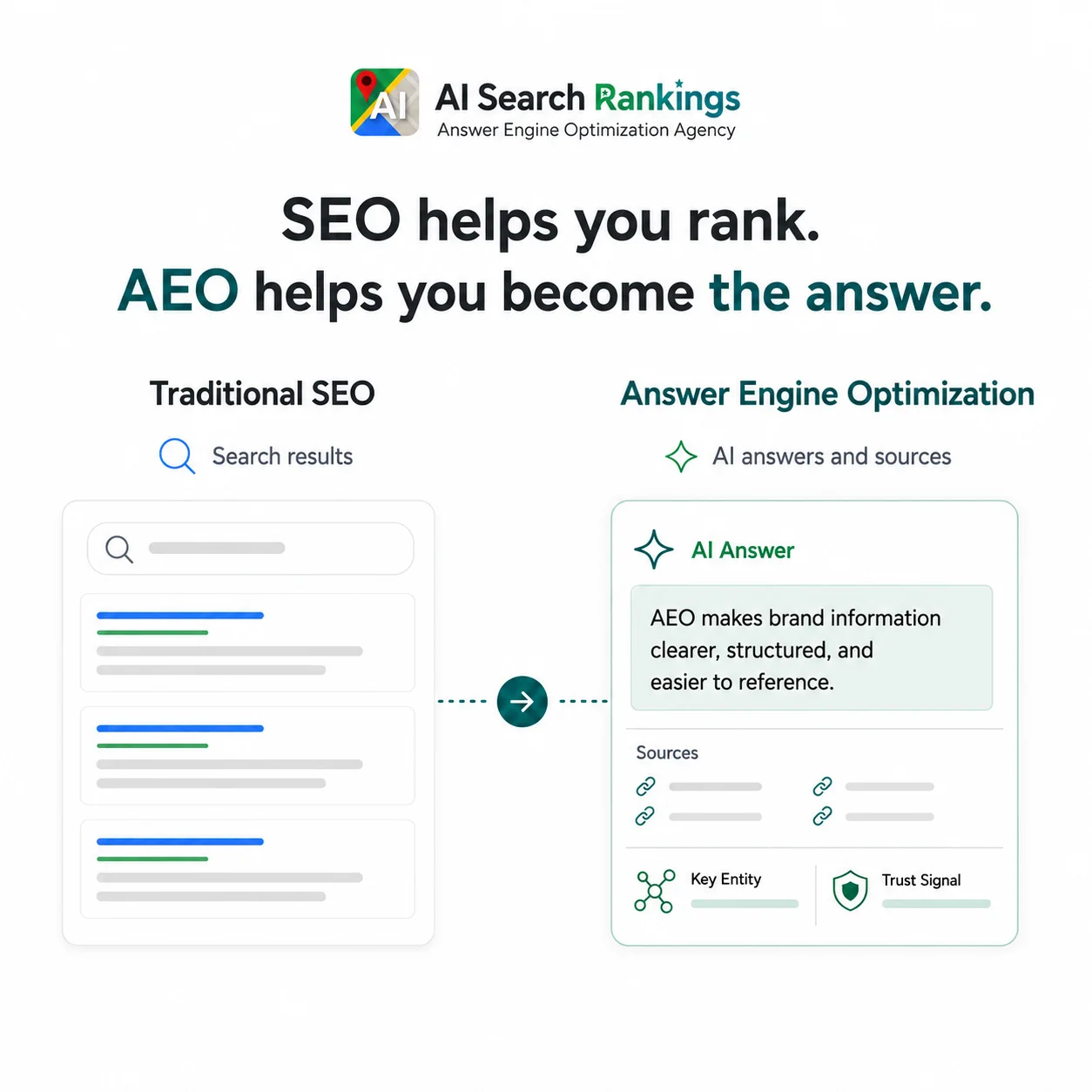
Answer Engine Optimization (AEO) aims for direct citations by AI search engines and AI Overviews, while Traditional Search Engine Optimization (SEO) targets organic listings on conventional search results pages. The core difference lies in the goal: AEO seeks to provide the precise, verifiable answer, whereas SEO focuses on driving clicks to a website.
The evolution of search from keyword matching to AI-driven answer generation demands a new approach to online visibility. AI search engines like Google AI Overviewsoogle-ai/" title="Learn more about Google AI" class="internal-link il-primary il-tracked" data-entity="Google AI" data-keyword-type="primary" rel="internal">Google AI Overviews, Google Gemini, and ChatGPT do not just list websites; they synthesize information to provide direct answers, often citing specific sources. This means businesses need to structure their content to be understood and directly quoted by these AI systems. AEO ensures your information is not only findable but also the authoritative source AI recommends.
Traditional SEO, while still relevant for many aspects of web presence, primarily focuses on optimizing for specific keywords, building backlinks, and improving technical website performance to rank high in a list of results. AEO encompasses these foundational elements but extends them to prepare content for semantic understanding, entity recognition, and helpfulness, which are critical for AI citation. It is a strategic shift from being found on a list to being the answer itself.
- Knowledge Block: Entity Understanding in AEO
- Entity understanding refers to an AI system's ability to identify and comprehend real-world objects, concepts, or people (entities) mentioned in text, not just keywords. For AEO, this means clearly defining your business, products, services, and expertise as distinct entities, then linking them semantically within your content. This helps AI systems form a complete, accurate knowledge graph about your business, making it easier to trust and cite your information.
Core Concepts
How Do AI Search Engines Process Information?
AI search engines use advanced natural language processing (NLP) and machine learning to understand the intent behind a query, not just the keywords, then synthesize information from various sources to provide a direct, concise answer.
Traditional search engines largely rely on indexing web pages based on keywords, links, and technical factors. They then present a ranked list of relevant results. AI search operates differently. When you ask Google AI Overviews a question, it uses sophisticated algorithms to break down your query, identify key entities, and determine the underlying intent. It then scans billions of data points, including web pages, databases, and structured data, to generate a synthesized answer. This process prioritizes accuracy, authoritativeness, and directness of information.
This means content must be structured to facilitate machine understanding. Clear headings, concise answers to specific questions, and explicit definitions of terms are vital. AI also evaluates the credibility of sources, favoring content from established authorities with strong E-E-A-T (Experience, Expertise, Authoritativeness, and Trustworthiness) signals. For businesses, this translates to a greater need for transparent, verifiable information presented in a machine-readable format.
Strategic Comparison
Comparing AEO and Traditional SEO Strategies
AEO requires a shift from optimizing for keyword rankings to optimizing for answer directness, semantic relevance, and AI citation, contrasting with traditional SEO's focus on organic SERP positions and website traffic.
| Aspect | Traditional SEO | Answer Engine Optimization (AEO) |
|---|---|---|
| Primary Goal | Achieve high organic search rankings and drive website clicks. | Become the direct, cited answer provided by AI search engines. |
| Content Focus | Keyword-rich, comprehensive articles targeting specific search queries. | Factual, concise, authoritative answers to questions; structured data for entities. |
| Technical Optimization | Crawlability, indexability, page speed, mobile-friendliness. | Enhanced schema markup, clear entity relationships, content clarity, trust signals. |
| Authority Signals | Backlinks from high-domain-authority websites, brand mentions. | E-E-A-T demonstration, verifiable facts, consistent brand identity across platforms. |
| User Experience | Website navigation, clear calls to action, engaging content. | Direct answer provision, instant helpfulness, fulfilling immediate user intent. |
| Measurement | Organic traffic, keyword rankings, conversion rates. | AI citation rate, answer box appearances, entity visibility, sentiment analysis. |
Key Pillars
What are the Four Pillars of an Effective AEO Strategy?
An effective AEO strategy builds upon four foundational pillars: Brand Clarity, Technical Infrastructure, Competitive Positioning, and Revenue Impact, ensuring content is optimized for AI understanding and business goals.
Brand Clarity
AI must clearly understand who your business is, what you offer, and your unique value proposition. This involves consistent naming, clear service definitions, and unambiguous messaging across all digital touchpoints.
Technical Infrastructure
Your website's backend needs to be robust and machine-readable. This includes proper schema markup, logical site structure, and fast loading times, which enable AI to efficiently crawl, parse, and interpret your data.
Competitive Positioning
Understanding how competitors are perceived and cited by AI helps you find gaps and unique angles. Differentiate your expertise by providing unique insights, data, or a distinct voice that AI can recognize as superior.
Revenue Impact
Every AEO effort should tie back to measurable business outcomes. This means optimizing for queries that lead to conversions, leads, or sales, directly influencing your financial growth through AI visibility.
Adapting Your Approach
How to Transition from Traditional SEO to AEO
Transitioning to AEO involves re-evaluating content creation, technical foundations, and audience engagement, with a focus on delivering verifiable, direct answers that AI can confidently cite.
The shift from traditional SEO to AEO is not about abandoning what works, but rather expanding and refining your strategy. It requires a deeper understanding of how AI processes and synthesizes information. Businesses must move beyond simply providing information to becoming the trusted source of answers.
Expert Note: Content Reframing
Instead of writing about broad topics, focus on answering specific, factual questions. Each piece of content should have a clear, concise answer to a distinct query, supported by evidence and structured for easy extraction by AI. Think of each page as a potential answer snippet.
Actionable Steps
Implementing the Local Answer System for AEO
The Local Answer System provides a structured six-stage process to optimize your business for AI search, ensuring local visibility and authoritative citations across AI platforms.
-
Find Your Current AI Visibility
Done when: You have a clear understanding of your business's current AI search presence and an AARS score report.Begin with a comprehensive AI visibility audit, like the Free AI Visibility Audit from AI Search Rankings. This evaluates your current standing across 47 readiness factors, providing an AI Answer Readiness Score (AARS). Identify where your business is currently found or missed by AI.
-
Fix Inaccuracies and Gaps
Done when: All core business information is consistent and accurate across major online platforms and directories.Address any inconsistent or outdated information about your business across online directories, local listings, and your website. Ensure your Google Business Profile is fully optimized, accurate, and consistent with your official website data. Correcting these foundational issues builds trust for AI.
-
Structure Content for AI Understanding
Done when: Your website content includes robust schema markup and is structured with question-led headings and direct answers.Implement schema markup (e.g., LocalBusiness, Product, Service, FAQ schema) to explicitly define entities and relationships on your website. Use clear, hierarchical headings (H1, H2, H3) and answer-first content structures. This helps AI parse your content effectively.
-
Prove Expertise and Authority (E-E-A-T)
Done when: Your content explicitly showcases the expertise of its authors and your business through verifiable credentials and examples.Develop content that demonstrates deep experience, expertise, authoritativeness, and trustworthiness. Include author bios, certifications, case studies, and real-world examples. AI prioritizes highly credible sources, so showcasing your credentials is vital.
-
Track Performance and AI Citations
Done when: You have a system in place to monitor AI citations and measure changes in your AARS over time.Monitor your performance not just by traditional SEO metrics, but by how often AI platforms cite your content directly. Track appearances in Google AI Overviews, ChatGPT responses, and other AI-driven answer boxes. Adjust your strategy based on these insights.
-
Grow Your Answer Authority
Done when: You have a continuous content plan focused on expanding your domain authority and answering user queries across your industry.Continuously expand your content to cover related questions and entities within your niche. Seek opportunities for third-party mentions and citations from other authoritative sources. Building a comprehensive and interconnected knowledge base reinforces your authority with AI.
Practical Application
How to Optimize Content for AI Overviews and ChatGPT
Optimizing content for AI Overviews and ChatGPT requires creating direct, factual answers, using structured data, and demonstrating clear topical authority to increase citation potential.
For AI Overviews, focus on answering the
Discover how your brand is cited and recommended across ChatGPT, Google AI Overviews, and Gemini with our free site-level audit.Verify Your AI Search Visibility