Key Takeaways
- Technical SEO for AEO shifts focus from keyword rankings to providing direct, verifiable answers that AI systems can easily understand and cite.
- Optimizing for voice search requires structuring content to answer natural language questions and appear in featured snippets and AI Overviews.
- Structured data, especially Schema.org markup, is critical for AI engines to interpret content context and entity relationships accurately.
- An effective AEO technical SEO strategy involves comprehensive audits, content optimization, structured data implementation, and continuous monitoring of AI visibility.
- Knowledge Block: Technical SEO for AEO
- Technical SEO in the AEO era is the process of optimizing website infrastructure, content structure, and data presentation to make information highly accessible, understandable, and trustworthy for AI search engines and voice assistants. It focuses on ensuring AI systems can easily find, process, and directly cite your content as the authoritative answer for user queries, rather than just ranking for keywords. This ensures your business appears in AI Overviews, featured snippets, and conversational AI responses across platforms like Google AI Overviewsoogle-ai/" title="Learn more about Google AI" class="internal-link il-primary il-tracked" data-entity="Google AI" data-keyword-type="primary" rel="internal">Google AI Overviews, ChatGPT, and Google Gemini.
Understanding the Shift
The Shift to AEO: Why Technical SEO Now Matters More
The rise of AI search engines and voice assistants fundamentally changes how users find information and how businesses must optimize their online presence.
In the past, technical SEO focused on crawling, indexing, and ranking for keywords in traditional search results. Today, AI Answer Enginetent/answer-engine-optimization/" title="Learn more about Answer Engine Optimization" class="internal-link il-primary il-tracked" data-entity="Answer Engine Optimization" data-keyword-type="primary" rel="internal">Answer Engine Optimization (AEO) moves beyond this. It ensures your website can provide direct, concise, and trustworthy answers that AI systems can extract and present in formats like Google AI Overviews, voice search results, and featured snippets. For your business, this means a direct path to being the cited authority, leading to more visibility and trust.
AI search engines value clarity, authority, and structured information above all else. They aim to deliver a single, definitive answer, not just a list of blue links. This shift means that solid technical SEO is no longer just about getting found; it is about being the chosen answer. Without proper technical foundations, even excellent content may be overlooked by AI systems.
Decoding Voice Search: Structure for Conversational AI
Optimizing for voice search and featured snippets positions your content as the go-to answer for direct questions posed to AI assistants.
Voice search queries are typically longer, more conversational, and question-based than typed queries. Users ask full questions like, “What is the best HVAC company near me?” or “How do I fix a leaky faucet?” To capture this traffic, your technical SEO must prepare your content to directly answer these questions.
This involves using schema markup, creating content sections that answer specific questions, and maintaining a clear, concise writing style. When AI systems can quickly identify a direct answer on your page, your content is more likely to be featured in a prominent position, such as a featured snippet or an AI Overview summary. These positions offer unparalleled visibility, making your business the first point of contact for many users.
- Knowledge Block: Featured Snippets and AI Overviews
- Featured snippets are selected search results displayed at the top of Google's organic results to directly answer a user's query, often appearing in paragraph, list, or table format. AI Overviews, like those in Google Search Generative Experience, take this further by synthesizing information from multiple sources into a comprehensive answer, frequently citing specific websites. Both formats are prime targets for AEO, as they represent the direct answers that AI systems prioritize and cite, significantly boosting visibility and authority for the chosen source.
AI Communication
Structured Data: The Language AI Understands
Implementing Schema.org structured data correctly is necessary for AI engines to interpret your content and identify key entities on your site.
Enhance AI Understanding
Structured data, using Schema.org vocabulary, provides explicit signals about the meaning of your content. This helps AI systems understand entities, relationships, and context on your pages beyond simple text analysis.
Boost Featured Snippet Potential
Pages with well-implemented structured data, such as FAQPage or HowTo schema, are more likely to be selected for featured snippets because AI can easily extract definitive answers.
Improve Semantic Search
Structured data helps AI understand the broader semantic web, linking your content to related entities and concepts. This strengthens your overall authority on a topic and improves visibility for complex queries.
Common Structured Data Mistakes
Avoid common errors like incomplete schema, mismatching visible content with schema data, or using incorrect schema types. These mistakes can prevent AI systems from trusting and utilizing your structured data, hindering your AEO efforts. Always validate your schema with tools like Google's Rich Results Test.
Honest Limitations
The Limitations To Know
Understanding the boundaries of technical Answer Engine Optimization helps you set realistic expectations for your visibility strategy.
While structured data and clean code make your content accessible to AI, they do not guarantee a specific outcome. Search engines and language models operate on proprietary algorithms that change frequently.
Where this does not help
- Third-Party Control Over Answer Selection You can format your content perfectly for AI extraction, but you cannot force an engine to cite it. Google and OpenAI use proprietary systems to decide when a query requires an AI response and which source provides the best answer. This selection process remains entirely outside your control.
- The Zero-Click Traffic Reality Securing a featured snippet or an AI Overview citation increases your brand visibility, but it often reduces direct website visits. When a user gets a complete answer directly from the voice assistant or search interface, they have no reason to click through to your page. You must measure success by brand impressions and citations rather than traditional click-through rates.
- Dependency on Real-World Brand Authority Technical optimization cannot compensate for a lack of actual industry trust. AI systems evaluate the broader entity authority of your business across the web before choosing to cite you. If your brand lacks external validation, perfect schema markup will not be enough to win the primary answer slot.
- Algorithmic Volatility and Feature Changes The interfaces for AI Overviews and voice search update constantly without warning. A format that successfully triggers a featured snippet today might stop working tomorrow if the search engine changes its display rules. Your technical strategy must adapt to these external shifts rather than relying on a static set of tactics.
What remains within your control
- You control the accuracy, depth, and structure of the information you publish.
- You control how clearly your business, services, and service area are described.
- You control how quickly you correct an error once it is found.
- You control the evidence you provide behind every claim you make.
Methodology
The AEO Technical SEO Process: 6 Steps to AI Visibility
Follow these strategic steps to optimize your website for AI search engines and secure prominent positions in voice search and featured snippets.
-
Conduct a Comprehensive Technical AEO Audit
Done when: You have a prioritized list of technical issues impacting AI search visibility and a clear understanding of your current AI Answer Readiness Score (AARS).Start with a deep audit of your website's technical health, focusing on AI readability. This involves evaluating crawlability, indexability, site speed, mobile-friendliness, and existing structured data. Identify technical barriers that prevent AI systems from fully understanding and accessing your content. AI Search Rankings offers a Free AI Visibility Audit to assess these factors.
-
Optimize for Voice Search Questions and Conversational Queries
Done when: Key pages on your site include sections explicitly answering common voice search questions, formatted for direct extractability.Research the natural language questions your target audience asks aloud to AI assistants. Adapt your content to directly answer these questions in concise, easy-to-digest formats. Structure headings and subheadings to reflect these conversational queries, creating clear question-and-answer pairs within your content.
-
Implement and Validate Advanced Structured Data
Done when: Critical pages have accurate and comprehensive structured data implemented and verified, improving AI's understanding of your page content.Apply relevant Schema.org markup to your content, going beyond basic types. Use specific schemas like
FAQPage,HowTo,Article,LocalBusiness, andProductto provide explicit context to AI. Ensure all structured data is accurate, complete, and validated using Google's Rich Results Test and Schema Markup Validator. -
Build Strong Internal Linking and Entity Relationships
Done when: Your internal link profile clearly establishes topic clusters and reinforces your site's expertise to AI systems.Create a logical internal linking structure that reinforces topical authority and demonstrates relationships between entities on your site. Use descriptive anchor text to guide AI systems through your content hierarchy. This helps AI connect concepts and understand the depth of your expertise on specific topics.
-
Ensure Technical Performance and Mobile Responsiveness
Done when: Your website consistently achieves strong Core Web Vitals scores and offers a seamless experience across all devices.Maintain fast page loading speeds, excellent Core Web Vitals, and full mobile responsiveness. AI systems prioritize user experience, and a technically performant site is more likely to be favored for featured snippets and AI Overviews. Slow, clunky, or non-mobile-friendly sites will be penalized.
-
Continuously Monitor AI Visibility and Adapt Strategy
Done when: You have an ongoing process for tracking AI visibility, identifying trends, and refining your AEO technical SEO approach based on performance data.Regularly track your presence in AI Overviews, featured snippets, and voice search results. Analyze which queries trigger your content and identify new opportunities or areas for improvement. AI Search Rankings' monthly monitoring helps you adapt your strategy to the evolving AI search market.
A Paradigmatic Shift
Entity SEO vs. Traditional Keyword SEO: A Critical Comparison
| Characteristic | Traditional Keyword SEO | AEO Technical SEO (Entity-Centric) |
|---|---|---|
| Primary Goal | Ranking for specific keywords in organic search results. | Becoming the authoritative, cited answer in AI Overviews, voice search, and featured snippets. |
| Content Focus | Keyword density, on-page optimization around target phrases. | Clarity, direct answers, comprehensive coverage of entities, and semantic relationships. |
| Technical Emphasis | Crawl budget, indexability, site speed (broadly). | Structured data (Schema.org), entity graph optimization, conversational query mapping, E-E-A-T signals. |
| Measurement of Success | Organic keyword rankings, traffic volume, click-through rates. | Featured snippet occupancy, AI Overview citations, voice search answer rate, Answer Readiness Score (AARS). |
| Future Impact | Less effective as AI becomes primary interface. | Foundational for sustained visibility and authority in the evolving AI search market. |
Performance Measurement
Measuring Your AEO Technical SEO Impact
Understanding the effectiveness of your technical AEO efforts requires tracking specific metrics and applying specialized evaluation frameworks.
Measuring success in the AEO era goes beyond traditional keyword rankings. You need to focus on metrics that directly reflect AI's ability to find, understand, and cite your content. This includes tracking your presence in featured snippets, monitoring for direct citations within Google AI Overviews or ChatGPT, and analyzing the accuracy of voice search responses.
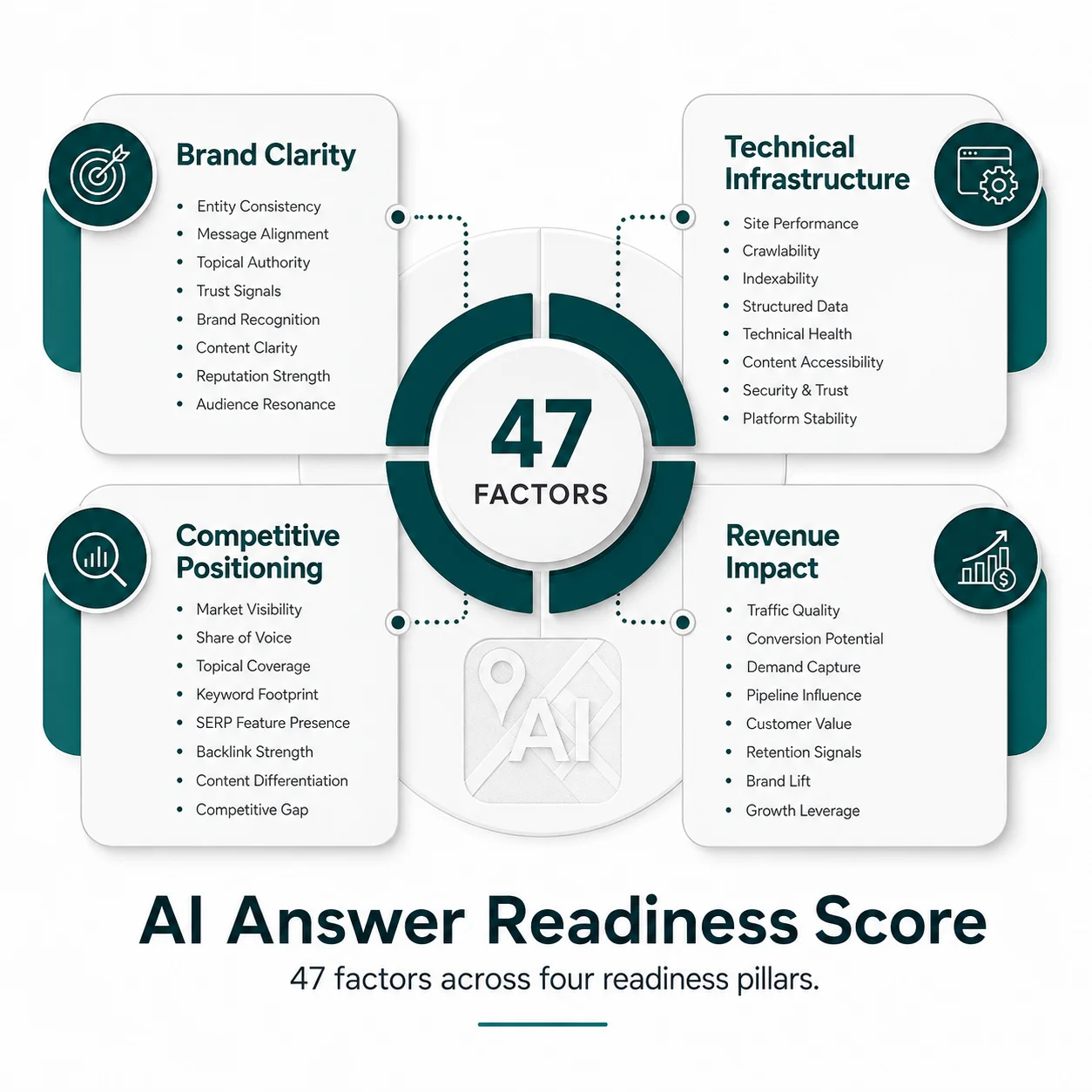
AI Search Rankings utilizes the proprietary AI Answer Readiness Score (AARS). This score evaluates 47 readiness factors across Brand Clarity, Technical Infrastructure, Competitive Positioning, and Revenue Impact. It gives you a clear, quantitative measure of how well your site is optimized for AI. Tracking your AARS allows you to see the direct impact of your technical SEO adjustments and refine your strategy for continuous improvement.
Expert Note: Beyond the Snippet
While featured snippets are valuable, the ultimate goal of AEO technical SEO is to establish your business as a trusted entity. This means building a robust entity graph around your brand and topics, so AI systems consistently recognize your authority across various forms of generative AI. This provides long-term, defensible AI visibility.
Mistakes To Avoid
Common Mistakes To Avoid
Keeping your technical foundation clean allows AI engines to access, understand, and cite your content without friction.
Even with excellent content, small technical missteps can prevent AI systems from reading your pages. Fixing these common errors removes the barriers between your business and AI search visibility.
Blocking AI crawlers in the robots file
Many site owners update their robots.txt file to block web scrapers but accidentally block AI bots like GPTBot or CCBot. They do this to protect their data without realizing how it affects visibility.
What it costs: AI search engines cannot crawl your site, meaning your business will never appear as a cited answer in AI Overviews or ChatGPT.
The correction: Review your robots.txt file to allow access to major AI crawlers while only blocking malicious scrapers.
Hiding direct answers behind client-side JavaScript
Developers often use JavaScript to create interactive accordions or tabs that hide text until a user clicks. AI crawlers allocate limited resources to render JavaScript and often skip hidden text.
What it costs: The AI engine misses your best answers entirely, giving the featured snippet to a competitor with a simpler HTML structure.
The correction: Serve your most important questions and answers in plain, server-rendered HTML that loads immediately on the page.
Using vague anchor text for internal links
Content creators frequently use phrases like "learn more" or "click here" to link to important service pages. This strips away the context that AI systems use to understand how topics connect.
What it costs: AI engines fail to map the entity relationships on your site, which lowers your topical authority for complex queries.
The correction: Use descriptive, entity-rich anchor text that tells the AI exactly what the destination page is about.
Formatting FAQs as dense paragraphs
Writers sometimes blend multiple questions and answers into a single long paragraph to make the page look like an essay. AI systems look for clear, distinct pairs to extract for voice search.
What it costs: The AI cannot isolate the specific answer it needs, so it chooses a different source that is easier to parse.
The correction: Use clear heading tags for each question and place a concise, two-sentence answer immediately below it.
Leaving outdated timestamps on evergreen content
Marketing teams often update the text of a guide or service page but forget to update the published or modified date in the metadata. AI systems check these dates to verify if the information is current.
What it costs: AI engines assume your answer is obsolete and recommend a competitor with a more recent timestamp.
The correction: Configure your content management system to automatically update the last modified date in both the visible text and the schema markup whenever you revise a page.
Partnering for AI Success
Future-Proofing with AI Search Rankings
AI Search Rankings helps businesses navigate the complexities of AI search, ensuring they become the trusted answer in a rapidly evolving market.
As an Answer Engine Optimization (AEO) agency, AI Search Rankings specializes in helping businesses become easier for AI search engines to find, understand, trust, cite, and recommend as the answer across ChatGPT, Google AI Overviews, Google Gemini, Google Maps, and search. Our methodology, the Local Answer System, involves six stages: Find, Fix, Structure, Prove, Track, and Grow. This comprehensive approach addresses all facets of AEO, from technical infrastructure to content strategy.
Jagdeep Singh, Founder and Lead Answer Engine Optimization Strategist, brings over 12 years of enterprise SEO experience to guide businesses through this transformation. By partnering with us, you gain access to expert strategies designed to secure your position in the AI-driven future of search. We offer packages like Local AI Answer Starter at $799 per month, Local AI Answer Growth at $1,500 per month, and Local AI Answer Authority at $3,500 per month, each tailored to different business needs.
Common Questions
Technical SEO and AEO Frequently Asked Questions
What is the biggest difference between traditional technical SEO and AEO technical SEO?
The biggest difference is the goal. Traditional technical SEO aims for keyword rankings and organic traffic. AEO technical SEO focuses on being the direct, cited answer for AI systems, leading to featured snippets, AI Overviews, and voice search responses. It prioritizes semantic understanding over simple keyword matching.
How important is structured data for AI search visibility?
Structured data is critically important. It acts as a direct communication channel to AI search engines, explicitly telling them what your content means and how different elements relate. Without it, AI systems must infer context, which can lead to missed opportunities for citation and lower visibility in AI-powered results.
Can I achieve featured snippets without structured data?
Yes, it is possible to appear in featured snippets without explicit structured data if your content is exceptionally well-organized and clearly answers a query. However, using relevant structured data types like FAQPage or HowTo significantly increases your chances, as it makes content extraction much easier and more reliable for AI systems.
How does voice search optimization impact my local business?
Voice search is highly localized. Many queries include phrases like "near me" or specific locations. Optimizing for voice search helps local businesses by ensuring their contact information, services, and operational hours are easily found and cited by AI assistants for local queries. This can directly lead to more foot traffic and phone calls.
Your Next Step
What To Do Next
Follow these steps to establish your technical baseline and start optimizing your website for AI search engines. The next step is set out below, along with what happens after you take it.
Moving from traditional keyword rankings to Answer Engine Optimization requires a clear understanding of your current technical infrastructure. You need to know exactly how AI systems view your website right now before you change any code or content.
Request a Free AI Visibility Audit
What you receive: You receive a detailed report mapping your current technical gaps and opportunities for voice search visibility.Submit your website URL to our team for a detailed technical evaluation. We analyze your current structured data, entity relationships, and technical infrastructure to see how easily AI engines can extract your answers.
Review your AI Answer Readiness Score
What you receive: You have a clear, objective metric that shows exactly where your technical SEO stands right now.We calculate your AI Answer Readiness Score based on 47 specific readiness factors. This evaluation covers your brand clarity, technical infrastructure, competitive positioning, and revenue impact.
Schedule a Strategy Session
What you receive: You walk away with a concrete action plan tailored to your specific business goals and technical constraints.Meet with our Answer Engine Optimization team to discuss your audit results. We prioritize the technical fixes that make the biggest impact on your ability to secure featured snippets and AI Overviews.
Launch a 90-Day AEO Sprint
What you receive: Your website is fully structured to serve as a direct, authoritative answer for AI search engines.Execute the prioritized technical fixes through our structured Local Answer System. We implement advanced Schema markup, optimize your content for conversational queries, and build strong entity relationships.
Select the action below to begin. You will receive a written assessment of where your business currently appears in AI search, and the specific corrections that would change it.
Taking these steps ensures your business stops competing for traditional clicks and starts securing the primary answer slot.
Ready to Become the Answer AI Recommends?
Get a complete AI visibility audit and a custom Answer Engine Optimization roadmap built for your business, your market, and your revenue goals.
No contracts. Cancel any time. Results you can verify.
Verify Your AI Search Visibility
Discover how your brand is cited and recommended across ChatGPT, Google AI Overviews, and Gemini with our free site-level audit.
Get Free AI Visibility Audit