Key Takeaways
- Answer Enginetent/answer-engine-optimization/" title="Learn more about Answer Engine Optimization" class="internal-link il-primary il-tracked" data-entity="Answer Engine Optimization" data-keyword-type="primary" rel="internal">Answer Engine Optimization (AEO) structures content for direct AI consumption and citation, unlike Traditional SEO which targets keyword rankings.
- AI search prioritizes direct answers and verifiable facts, making traditional keyword stuffing less effective for visibility.
- Businesses must build entity authority and semantic relevance to appear as trusted sources in AI Overviews and ChatGPT.
- The AI Answer Readiness Score (AARS) identifies 47 factors critical for AI visibility across Brand Clarity, Technical Infrastructure, Competitive Positioning, and Revenue Impact.
Understanding the Shift
Why Traditional SEO Alone No Longer Secures Top Search Visibility
The way people find information has changed significantly with the rise of AI. This section explains why traditional SEO strategies are becoming less effective and why a new approach is necessary for businesses.
For decades, Traditional Search Engine Optimization (SEO) focused on ranking web pages high on Google's search results pages for specific keywords. The goal was to drive traffic by appearing early in the "10 blue links." This approach aimed for organic visibility on search engine results pages, or SERPs.
Today, AI search engines such as Google AI Overviewsoogle-ai/" title="Learn more about Google AI" class="internal-link il-primary il-tracked" data-entity="Google AI" data-keyword-type="primary" rel="internal">Google AI Overviews, Google Gemini, and ChatGPT do not simply list links. They provide direct answers, summarize information, and cite sources. This fundamental shift requires a different optimization strategy: Answer Engine Optimization (AEO).
Core Concepts
What is the Core Difference Between AEO and Traditional SEO?
AEO aims for direct AI citation, while Traditional SEO targets organic rankings. Understanding this distinction helps businesses adapt their digital strategies.
The primary difference lies in the target outcome. Traditional SEO optimizes your website to rank for keywords in web search results. The goal is to get clicks to your website.
Answer Engine Optimization (AEO) optimizes your content to be directly consumed, understood, and cited by AI models. The goal is to become the direct answer or a trusted source that AI systems recommend. This shift moves beyond mere visibility to authoritative credibility.
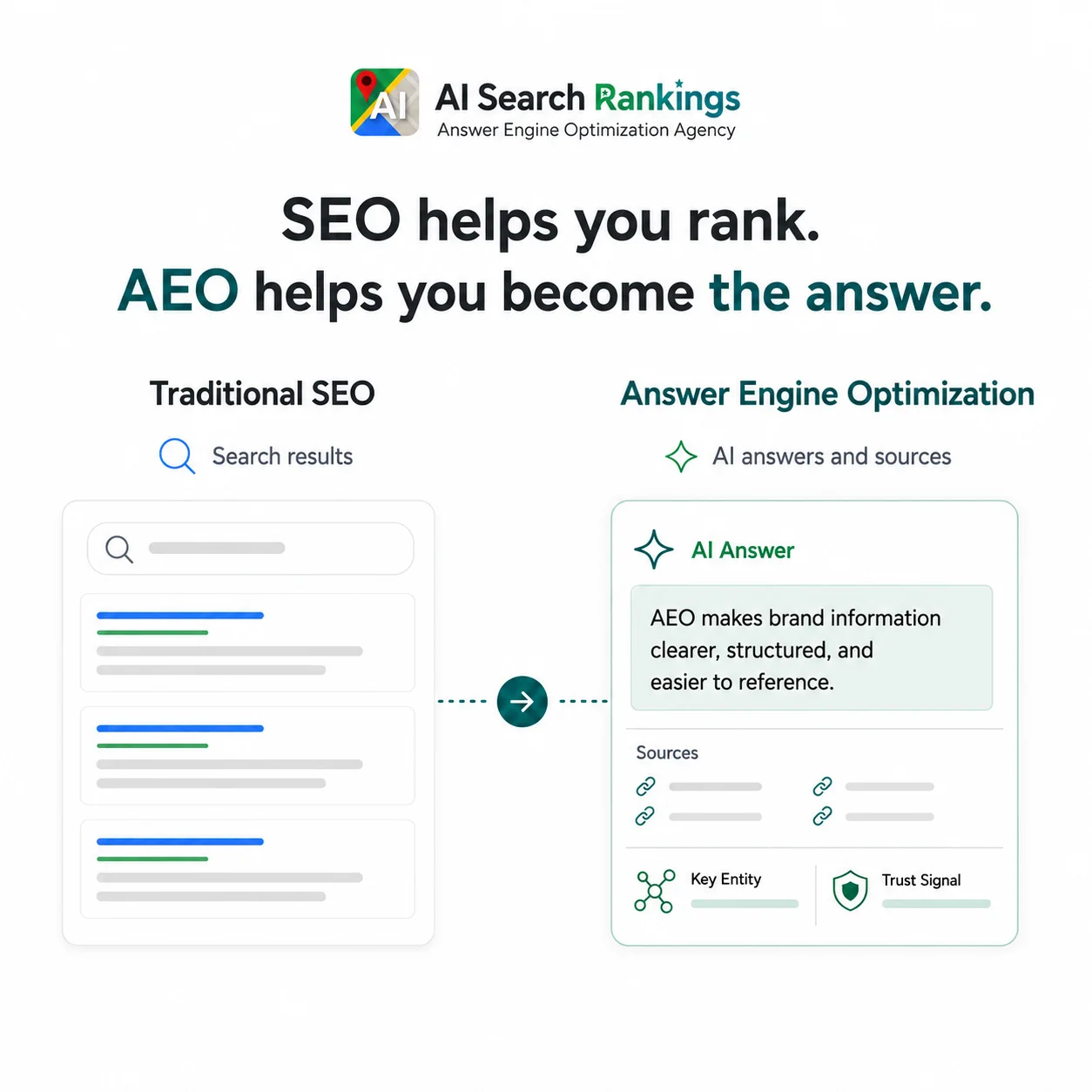
- Knowledge Block: Answer Engine Optimization (AEO)
- Answer Engine Optimization (AEO) is a specialized digital strategy that helps businesses become easier for AI search engines to find, understand, trust, cite, and recommend as the answer across platforms like ChatGPT, Google AI Overviews, Google Gemini, and Google Maps. It focuses on structuring content with semantic relevance, explicit entities, and verifiable facts to ensure direct AI consumption and accurate citation. AEO prioritizes factual accuracy and explicit relationships over keyword density.
Evolution of Search
Why Has the Shift from Traditional SEO to AEO Occurred?
The market of information retrieval has changed dramatically, driven by advancements in artificial intelligence. This section explains the underlying reasons for the rise of AEO.
The Old Approach
Traditional SEO's Declining Efficacy
Traditional SEO, while still relevant for some aspects of web search, faces significant limitations in the AI era. It primarily optimized for keyword density, backlinks, and technical factors aimed at pleasing traditional web crawlers. This approach often resulted in content focused on ranking for phrases rather than providing comprehensive, verifiable answers. AI systems frequently bypass these "10 blue links" by synthesizing information directly, making pure click-through rates a less reliable metric of visibility.
The AEO Approach
The Rise of Answer Engines and AI Overviews
The emergence of sophisticated AI models has transformed search from a list of links to an interactive answer experience. Users now expect direct, concise answers to complex questions, often within the search interface itself. Google AI Overviews, for instance, summarize information from multiple sources, reducing the need for users to click through to individual websites. AEO addresses this by preparing content to be readily understood and cited by these AI systems, ensuring your business remains a visible and trusted source in this new environment.
Expert Note: AI Model Citation
AI models do not simply "scrape" websites. They process and synthesize information, building a knowledge graph of entities and relationships. To be cited, your content must be structured in a way that clearly communicates these facts and their connections, allowing the AI to integrate it into its understanding of the world.
Business Outcomes
How Does AEO Directly Impact Business Visibility and Revenue?
AEO helps businesses secure direct citations from AI, which translates into increased brand recognition and more qualified customer interactions.
Direct AI Citations
When AI models cite your business as the answer, it establishes immediate authority. This positions your brand as a verifiable expert in your industry, directly answering user queries.
Increased Qualified Leads
Users interacting with AI often have specific needs. When AI recommends your business, those leads are typically more informed and closer to a purchase decision, improving conversion rates.
Enhanced Brand Trust
Being a go-to source for AI builds significant trust with your audience. People trust information presented by AI systems, and your brand benefits from this association through repeated citations.
Local Business Advantage
AEO significantly boosts visibility for local businesses on platforms like Google Maps. Optimizing for local entities helps AI recommend your services to nearby customers searching for specific solutions.
Future-Proofing Your Presence
As AI search capabilities evolve, businesses optimized for AEO are better prepared. Investing in AEO ensures your digital presence remains strong as search trends continue to shift towards intelligent answers.
Verifiable Performance Metrics
AEO provides clear metrics for tracking AI citations and direct answer placements. This allows for precise measurement of your strategy's effectiveness and its direct impact on business goals.
Strategic Comparison
What are the Key Strategic Differences in AEO vs. Traditional SEO?
This table provides a direct comparison of the fundamental strategic approaches, focus areas, and goals of AEO and Traditional SEO.
| Feature | Traditional SEO | Answer Engine Optimization (AEO) |
|---|---|---|
| Primary Goal | Rank for keywords and drive organic traffic to websites. | Be directly cited by AI models and recommended as the authoritative answer. |
| Content Focus | Keyword-rich articles, blog posts, and landing pages for SERPs. | Fact-based, explicit content structured for AI comprehension and entity recognition. |
| Technical Optimization | Crawlability, indexability, page speed, mobile-friendliness, XML sitemaps. | Schema markup, entity graphs, knowledge panel optimization, canonical data sources, API readiness. |
| Authority Signals | Backlinks from high-domain-authority websites, social shares. | Verifiable factual accuracy, transparent sources, expert author credibility, cross-platform entity consistency. |
| User Interaction | Clicking a link to visit a website. | Receiving a direct answer or recommendation within the AI interface or search overview. |
| Measurement & Metrics | Organic traffic, keyword rankings, bounce rate, time on page. | AI citation volume, direct answer placements, knowledge panel mentions, AI-driven referral leads. |
| Future Preparedness | Adapting to algorithm updates for web search. | Proactively structuring content for evolving AI capabilities and new generative search experiences. |
Our Approach
What is the AI Search Rankings' AEO Methodology?
AI Search Rankings uses a structured six-stage process called the Local Answer System to help businesses achieve and maintain AI visibility.
Find Your Current AI Visibility
Done when: You receive a comprehensive AARS report detailing your AI search presence and identified gaps.We start with a Free AI Visibility Audit, providing an AI Answer Readiness Score (AARS). This score evaluates 47 readiness factors across Brand Clarity, Technical Infrastructure, Competitive Positioning, and Revenue Impact. It identifies where your business currently stands in AI search.
Fix Technical and Content Gaps
Done when: All identified technical errors and factual inconsistencies that hinder AI comprehension are remediated.Based on the audit, we address critical technical infrastructure issues and content deficiencies. This includes optimizing your website for AI crawlability, ensuring clear entity declarations, and resolving conflicting information across your digital footprint.
Structure Content for AI Consumption
Done when: Your key service and product pages feature enhanced schema, clear entity definitions, and answer-first content structures.We transform your content into an AI-friendly format using advanced schema markup and semantic optimization. This makes your information easily parsable and directly consumable by generative AI models, increasing the likelihood of direct citations.
Prove Authority and Expertise
Done when: Your content explicitly demonstrates expertise and is supported by verifiable data points or recognized credentials.Building authority involves demonstrating verifiable expertise (E-E-A-T) to AI. This includes establishing credible author profiles, ensuring factual accuracy, and aligning your content with authoritative external sources. We work to make your brand a trusted source.
Track AI Visibility and Citations
Done when: You receive regular reports detailing specific AI citation metrics and their impact on your business goals.We implement robust monitoring systems to track your performance in AI search. This includes tracking direct AI citations, knowledge panel appearances, and visibility in AI Overviews, providing transparent data on your AEO effectiveness.
Grow Your Answer Engine Dominance
Done when: Your business consistently appears as a primary source for relevant AI queries and continues to expand its AI footprint.AEO is an ongoing process. We continuously refine your strategy, expand your authoritative content, and adapt to evolving AI capabilities. The goal is to consistently increase your share of AI-driven answers and recommendations.
Implementation Challenges
What Challenges Do Businesses Face in Adopting AEO?
Transitioning to AEO presents new technical and strategic hurdles that require specialized knowledge and a forward-thinking approach.
Advantages of Adopting AEO
- Securing direct AI citations establishes your brand as an authority early in the customer journey.
- Improved discoverability across new AI search interfaces, including voice assistants and generative search.
- Higher quality leads from users who received a direct, specific AI recommendation.
- A future-proof strategy that adapts to the ongoing evolution of search technology.
- Enhanced brand reputation and trust when consistently cited as a reliable source by AI.
Limitations to Consider
- Requires a deep understanding of semantic web technologies and advanced schema markup beyond basic SEO.
- Content must be meticulously fact-checked and maintained for accuracy to avoid AI penalties.
- Measuring success needs new metrics beyond traditional keyword rankings, focusing on citations and answer placements.
- Demands ongoing adaptation as AI models and their consumption patterns evolve rapidly.
- Initial investment in technical infrastructure and expert content creation can be significant.
Common Questions
Frequently Asked Questions About AEO vs. Traditional SEO
Does AEO replace Traditional SEO completely?
No, AEO does not completely replace Traditional SEO. It is an evolution and expansion. Traditional SEO still plays a role in optimizing for conventional web search results and technical foundations. AEO builds upon these fundamentals, focusing on how AI understands and uses information.
How long does it take to see results from AEO?
Seeing results from AEO can vary, much like Traditional SEO. Initial technical and content optimizations can show impact within a few months, especially for local businesses. However, establishing deep authority and consistent AI citations is an ongoing process that yields increasing returns over time.
Is AEO only for large enterprises?
AEO is beneficial for businesses of all sizes, including small and medium-sized enterprises. For local businesses, AEO offers a significant advantage in being recommended on Google Maps and through local AI queries. The core principles of clear, authoritative content apply universally.
What is the AI Answer Readiness Score (AARS)?
The AI Answer Readiness Score (AARS) is a proprietary diagnostic tool from AI Search Rankings. It evaluates 47 critical factors across Brand Clarity, Technical Infrastructure, Competitive Positioning, and Revenue Impact to assess a business's current readiness for AI search visibility. It provides a clear roadmap for AEO improvement.
How does AEO help with local search?
AEO dramatically enhances local search visibility by ensuring your business's foundational information, services, and location are explicitly understood by AI. This leads to direct recommendations in local AI Overviews, Google Maps, and other location-aware AI applications, connecting you with nearby customers.
Ready to Become the Answer AI Recommends?
Get a complete AI visibility audit and a custom Answer Engine Optimization roadmap built for your business, your market, and your revenue goals.
No contracts. Cancel any time. Results you can verify.
Verify Your AI Search Visibility
Discover how your brand is cited and recommended across ChatGPT, Google AI Overviews, and Gemini with our free site-level audit.
Get Free AI Visibility Audit