Key Takeaways
- Answer Engine Optimization (AEO) success moves beyond traditional rankings to focus on AI visibility, citation, and direct recommendations.
- New AEO metrics include Answer Box visibility, featured snippet citations, AI Assistant recommendations, and Knowledge Graph presence.
- Tracking your AI Answer Readiness Score (AARS) provides a comprehensive evaluation of your brand's preparedness for AI search.
- Implementing an AEO measurement framework requires defining AI-specific goals, identifying data sources, and analyzing user engagement with AI-generated answers.
Defining AEO Success
What Defines Success in Answer Engine Optimization?
Measuring success in Answer Engine Optimization means evaluating your brand's presence, citation, and recommendation across AI search platforms, rather than just traditional keyword rankings.
In the evolving market of AI-powered search, the definition of online visibility has fundamentally changed. Businesses need to understand how AI models, like those powering Google AI Overviewsoogle-ai/" title="Learn more about Google AI" class="internal-link il-primary il-tracked" data-entity="Google AI" data-keyword-type="primary" rel="internal">Google AI href="/content/ai-overviews/" title="Learn more about AI Overviews" class="internal-link il-primary il-tracked" data-entity="AI Overviews" data-keyword-type="primary" rel="internal">AI Overviews and ChatGPT, discover, process, and present information. Success in AEO means your brand is not just found, but actively cited and recommended as the authoritative answer.
- Knowledge Block: Answer Engine Optimization Success
- AEO success is achieved when an AI search engine, such as Google Gemini or Microsoft Copilot, directly references your content, cites your brand as an authority, or recommends your business as a solution to a user's query. This goes beyond simple website traffic to encompass direct answer visibility, brand trust signals, and structured data accuracy that AI systems prioritize. It ensures your business is the first and most trusted answer when a user asks an AI system a question related to your products or services.
This shift requires new analytical approaches. Companies must move beyond simply tracking organic traffic or keyword positions. Instead, focus on how frequently your brand appears in direct answer formats, how often AI assistants mention your services, and the accuracy of your business information when presented by these systems. Your measurement strategy must align with how AI interprets and delivers information.
The Measurement Gap
Why Traditional SEO Metrics are Insufficient for AI Search
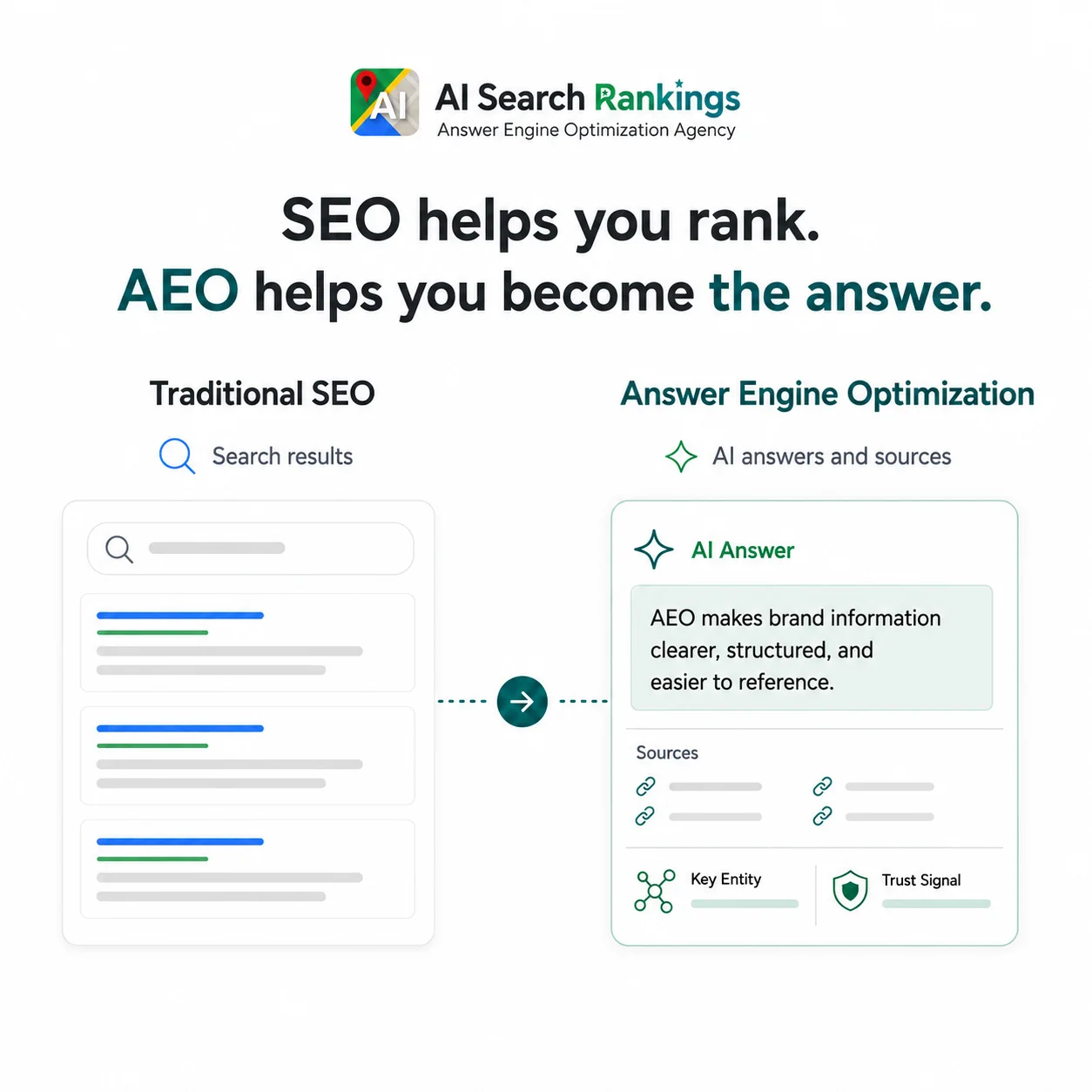
Traditional SEO metrics, designed for ten blue links, often fail to capture the nuanced visibility and influence your brand has within AI-generated answers.
Metrics like organic keyword rankings and click-through rates (CTR) remain valuable for traditional search engine results pages (SERPs). However, AI-powered search changes the user experience. Users often receive a direct answer from an AI Overview or assistant, reducing the need to click through to a website. This means a high ranking alone does not guarantee visibility or interaction if the AI provides the answer directly.
For example, if an AI Overview synthesizes information from several sources to answer a complex question, simply being ranked on the first page of Google might not mean your content is cited. You need to analyze whether your content is explicitly named or linked within that AI-generated summary. The core issue is that traditional metrics measure clicks to your site, while AEO metrics measure direct information gain and citation from AI systems, even if no click occurs.
Core Indicators
Key AEO Metrics for Measuring AI Visibility
New Answer Engine Optimization metrics focus on how well your brand performs within AI environments, ensuring you measure actual AI presence and influence.
AI Answer Box Citations
This metric tracks how often your content is specifically cited within direct answer boxes, featured snippets, or AI Overviews. It indicates authority and direct information gain by AI models.
AI Assistant Recommendations
Measure how frequently your brand or services are recommended by conversational AI assistants like ChatGPT, Google Gemini, or Microsoft Copilot. This reflects direct AI endorsement.
Knowledge Graph Presence
Assess the completeness and accuracy of your brand's presence in knowledge panels and Google's Knowledge Graph. A strong presence here feeds directly into AI responses.
Local AI Visibility
For local businesses, track citations and recommendations within Google Maps AI, local packs, and voice search results for local queries. This is critical for driving local foot traffic.
Semantic Relationship Score
Evaluate how well AI understands the relationships between your content, products, and services to relevant entities. This helps AI connect your brand to broader topics and user intent.
Trust and Authority Signals
Monitor AI's perception of your brand's expertise, authoritativeness, and trustworthiness (E-E-A-T) signals. These signals are critical for AI systems to recommend your content.
Diagnostic Framework
Tracking Your AI Answer Readiness Score
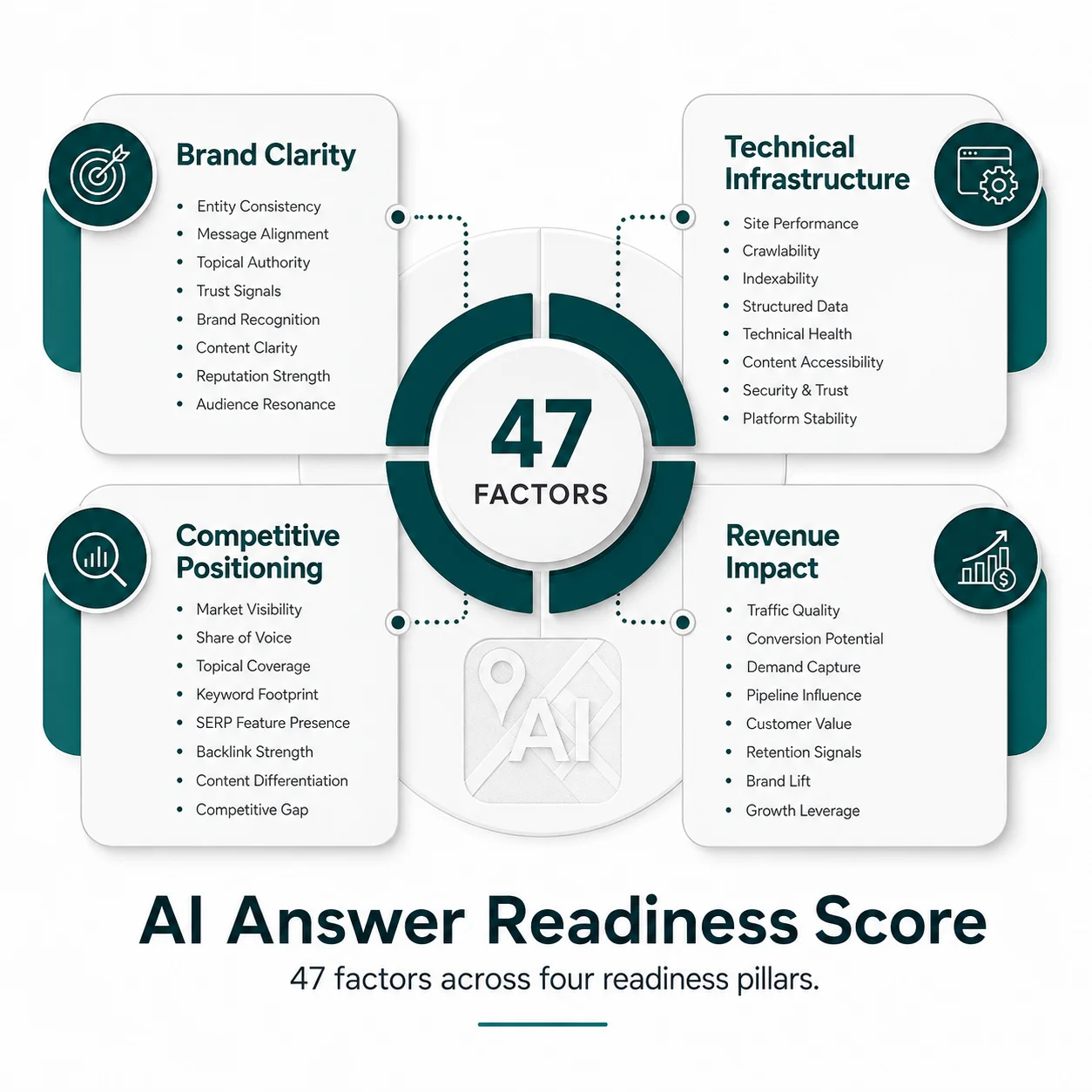
The AI Answer Readiness Score (AARS) provides a quantitative and qualitative assessment of your business's ability to be found, understood, and recommended by AI search engines.
The AI Answer Readiness Score (AARS) is a proprietary framework developed by AI Search Rankings. It evaluates your business across 47 readiness factors. These factors are categorized into four critical pillars: Brand Clarity, Technical Infrastructure, Competitive Positioning, and Revenue Impact. AARS provides a clear, actionable benchmark.
Monitoring your AARS over time allows you to see the direct impact of your Answer Engine Optimization efforts. A rising AARS indicates improved AI visibility, stronger citation potential, and a higher likelihood of being recommended by AI. This score helps decision-makers understand their current standing and where to focus resources for maximum AEO impact. It shifts the focus from vanity metrics to measurable preparedness for the AI search era.
Implementation Steps
Developing Your AEO Measurement Framework
Establishing an AEO measurement framework helps you systematically track, analyze, and improve your brand's performance in AI search environments.
-
Define AI-Specific Goals
Done when: You have a list of specific, measurable AEO goals with clear target metrics and timelines.Clearly state what you want to achieve with AEO. Examples include increasing brand citation in Google AI Overviews by 20% or being recommended by ChatGPT for specific product categories. Align these goals with overall business objectives.
-
Identify Data Sources and Tools
Done when: You have identified and configured the primary data sources and tools needed to collect AEO performance metrics.Determine where you will gather your AEO data. This includes AI search consoles, third-party AEO analytics tools, API access to large language models (LLMs) for programmatic checks, and monitoring tools for local citations and knowledge graph entries.
-
Track AI Visibility and Citation
Done when: You have a consistent process for tracking AI answer box visibility, direct citations, and brand mentions across key AI platforms.Regularly monitor how often your brand and content appear in direct AI answers, recommendations, and knowledge panels. Use advanced search operators and specialized tools to identify specific citations and mentions.
-
Analyze User Engagement with AI Answers
Done when: You are collecting and analyzing data on post-AI answer user behavior and sentiment related to your brand.Evaluate how users interact with AI-generated answers that reference your brand. This includes tracking follow-up queries, direct actions taken from AI recommendations, and sentiment analysis of AI conversations about your business.
-
Refine Content for AI Comprehension
Done when: You have implemented content adjustments based on AEO performance analysis to improve AI comprehension and citation potential.Use your AEO measurement data to inform content strategy. Optimize content for clarity, conciseness, and structured data, making it easier for AI models to parse, understand, and cite accurately. Focus on answering specific user questions directly.
Key Differences
Comparing Old and New: SEO Metrics Versus AEO Metrics
| Measurement Area | Traditional SEO Metric | Answer Engine Optimization (AEO) Metric |
|---|---|---|
| Visibility Goal | Website ranking on SERPs (page 1, position 1-10) | Direct answer citation, AI recommendation, Knowledge Panel presence |
| Traffic Source | Organic clicks to website from search results | AI-driven impressions, direct referrals from AI Overviews, voice search mentions |
| Content Effectiveness | Keyword density, content length, internal links | Clarity, conciseness, semantic relevance, structured data accuracy, E-E-A-T signals |
| Engagement Metric | Click-Through Rate (CTR), time on page, bounce rate | AI citation rate, user query satisfaction (post-AI answer), brand mention velocity |
| Success Indicator | Increased organic traffic and keyword positions | Increased AI Answer Readiness Score (AARS), higher direct answer share of voice, more AI-driven leads |
Common Challenges
Avoiding Common Pitfalls in AEO Measurement
Many businesses encounter specific challenges when transitioning to AEO measurement. Recognizing and addressing these pitfalls ensures your efforts remain effective and data-driven.
A common mistake is treating AEO as a simple extension of SEO. While some principles overlap, the metrics and analytical approaches for AI are distinct. Forgetting this can lead to misinterpreting data and making ineffective strategic decisions. Another pitfall is the reliance on incomplete data. AI search performance is often fragmented across various platforms, requiring a consolidated view to truly understand impact.
Common Mistake: Ignoring Intent Shift
Focusing solely on traditional keyword intent can cause you to miss the conversational and task-oriented intent that drives many AI queries. AI users often ask questions or seek direct actions, not just information, so your content and measurement must reflect this shift in user behavior.
Finally, some businesses fail to adapt their content fast enough. AEO requires agile content optimization, ensuring that your information is always current, accurate, and structured for AI consumption. Consistent monitoring and rapid iteration based on new AI model behaviors are key to sustained success.
Expert Partnership
Partnering for Advanced AEO Measurement
AI Search Rankings helps businesses develop and implement robust AEO measurement strategies, ensuring accurate tracking and actionable insights for AI visibility.
Navigating the complexities of AI search measurement requires specialized expertise. AI Search Rankings, an Answer Engine Optimization (AEO) agency, brings 12+ years of enterprise SEO experience to this new frontier. We understand the nuances of how AI systems discover, process, and present information, and we build measurement frameworks that deliver real value.
- Knowledge Block: AI Search Rankings Approach to Measurement
- AI Search Rankings integrates proprietary tools and expert analysis to provide a comprehensive view of your AEO performance. We measure your AI Answer Readiness Score (AARS), track AI citation frequency, monitor local AI visibility across platforms like Google Maps, and analyze user interaction patterns with AI-generated answers. Our approach provides clear, verifiable data on how AI systems perceive and recommend your brand, allowing for continuous optimization and strategic adjustments.
Our engagement path starts with a Free AI Visibility Audit, providing an initial AARS score for your business. This leads to a Strategy Session where we outline a tailored 90-Day AEO Sprint focused on measurable outcomes. We ensure you have the metrics and analytics needed to prove your success in the AI era.
Common Questions
Frequently Asked Questions About AEO Measurement
What is the primary difference between SEO and AEO measurement?
The primary difference is the focus. SEO measurement largely tracks clicks to your website and organic rankings, while AEO measurement focuses on how often AI systems directly cite, recommend, or synthesize information from your brand in their answers, even if a user does not click through to your site.
How do I track AI Assistant recommendations for my business?
Tracking AI Assistant recommendations involves monitoring mentions of your brand or products within conversational AI outputs. This can be done through dedicated AEO tools that simulate user queries, manual checks across platforms like ChatGPT or Gemini, and analyzing web analytics for referral traffic from AI-generated summaries.
What is the AI Answer Readiness Score (AARS) and why is it important?
The AI Answer Readiness Score (AARS) is a proprietary diagnostic tool that evaluates 47 factors across Brand Clarity, Technical Infrastructure, Competitive Positioning, and Revenue Impact. It is important because it provides a comprehensive, objective measure of how prepared your business is to be found, understood, and recommended by AI search engines.
Can I use my existing SEO tools for AEO measurement?
While some existing SEO tools can provide foundational data like keyword performance, they are often not designed to specifically track AI citations, recommendations, or Knowledge Graph completeness. You will need specialized AEO tools or expertise to capture the full spectrum of AI search performance metrics effectively.
Looking Ahead
The Future of Digital Visibility is Measurable
Adapting your measurement strategy for Answer Engine Optimization is not optional; it is a critical step towards securing your brand's future visibility and influence in the AI era.
The shift to AI-powered search is fundamentally reshaping how businesses connect with their audiences. Traditional metrics, while still relevant for some aspects, no longer tell the whole story. To truly thrive, you must embrace new metrics and analytics that reflect AI's unique mechanisms of discovery, understanding, and recommendation.
By focusing on AEO metrics such as AI answer box citations, AI assistant recommendations, and your AI Answer Readiness Score, you gain a clear, actionable understanding of your brand's performance. This allows for informed strategic decisions, targeted content optimization, and a stronger position as the trusted answer in an AI-first world. Businesses that proactively measure their AEO success will be better equipped to adapt, innovate, and capture new opportunities in the rapidly evolving market.
Ready to Become the Answer AI Recommends?
Get a complete AI visibility audit and a custom Answer Engine Optimization roadmap built for your business, your market, and your revenue goals.
No contracts. Cancel any time. Results you can verify.
Verify Your AI Search Visibility
Discover how your brand is cited and recommended across ChatGPT, Google AI Overviews, and Gemini with our free site-level audit.
Get Free AI Visibility Audit