Understanding AI Tools for Business
Enhance Business Insights with Python NLP Libraries
Natural Language Processing, or NLP, helps computers understand, interpret, and generate human language. Python offers several powerful libraries that can transform how businesses extract insights from text data, automate communication, and improve customer experiences.
Choosing the right NLP library for Python impacts your project's performance, scalability, and ease of development. This guide details the top NLP libraries available, explains their core capabilities, and provides practical advice for business owners and marketing directors looking to integrate advanced language processing into their operations.
Key Takeaways
- SpaCy offers high performance and a streamlined API, making it ideal for production-ready applications requiring speed and efficiency.
- NLTK provides a broad suite of algorithms and corpora, serving as a robust foundation for academic research and educational purposes in NLP.
- Hugging Face Transformers excels with state-of-the-art deep learning models for tasks like sentiment analysis and language generation, supporting complex AI applications.
- Gensim is specifically designed for unsupervised topic modeling and document similarity, efficient for large text corpora.
- TextBlob simplifies common text processing tasks with an intuitive interface, making it suitable for quick prototypes and basic analysis.
- Knowledge Block: Natural Language Processing (NLP)
- Natural Language Processing, or NLP, is a branch of artificial intelligence that gives computers the ability to understand, interpret, and generate human language. It combines computational linguistics, computer science, and AI to bridge the gap between human communication and computer understanding. Businesses use NLP for tasks like sentiment analysis, chatbot development, information extraction, and automated content generation to gain deeper insights from unstructured text data and automate language-based processes.
Strategic Advantage
Why Python Excels for NLP Development
Python is the preferred language for NLP due to its simplicity, extensive library ecosystem, and strong community support, which accelerates development and deployment of language-based AI solutions.
Python offers a syntax that is easy to learn and read, reducing development time for complex NLP projects. Its large number of specialized libraries means developers can access pre-built functionalities for almost any NLP task, from basic tokenization to advanced deep learning models. This rich ecosystem allows businesses to implement sophisticated language processing without starting from scratch.
The Python community also provides extensive documentation, tutorials, and support, which is invaluable for both seasoned developers and those new to NLP. also, Python integrates well with other data science and machine learning tools, making it a versatile choice for comprehensive AI pipelines that combine language understanding with other analytical components.

Honest Limitations
The Limitations Of Best Nlp Libraries for Python
This section outlines the operational boundaries of Python natural language processing libraries and the external factors that dictate their success.
While these tools provide powerful text analysis capabilities, they are not standalone solutions. Their effectiveness relies heavily on your infrastructure, your data quality, and the inherent complexity of human communication.
Where this does not help
- High dependency on input data quality. Python libraries cannot generate accurate insights from messy, incomplete, or biased text. The output quality depends entirely on your internal data collection practices. Fixing poor data architecture remains a human task that falls completely outside the control of any algorithm.
- Inability to understand deep cultural context and sarcasm. Even the most advanced transformer models struggle to interpret sarcasm, regional idioms, and subtle emotional cues accurately. This limitation depends on the unpredictable nature of human language evolution. You cannot control how customers express themselves, which means automated sentiment analysis will always carry a margin of error.
- Hidden infrastructure and computational costs. Deploying heavy models from libraries like Hugging Face requires significant processing power and memory. The actual performance depends on your cloud hosting environment and hardware investments. The rising cost of graphics processing units is a market condition that no open-source library can mitigate.
- Poor performance on niche industry jargon. Pre-trained models learn from general internet text and often fail to understand specialized medical, legal, or technical vocabulary. Achieving accuracy in these fields depends on expensive manual fine-tuning and custom dataset creation. The availability of clean, domain-specific training data is an external constraint that businesses must solve independently.
What remains within your control
- You control the accuracy, depth, and structure of the information you publish.
- You control how clearly your business, services, and service area are described.
- You control how quickly you correct an error once it is found.
- You control the evidence you provide behind every claim you make.
Understanding these boundaries helps you allocate the right budget for data preparation and human oversight before deploying an automated language system.
Library Evaluation
Comparing Top Python NLP Libraries for Business Needs
| Feature | NLTK (Natural Language Toolkit) | SpaCy | Hugging Face Transformers | Gensim | TextBlob |
|---|---|---|---|---|---|
| Primary Focus | Research, education, foundational tasks | Production-ready NLP, efficiency | Deep learning, state-of-the-art models | Topic modeling, document similarity | Simple text processing, rapid prototyping |
| Key Strengths | Broad algorithm collection, extensive corpora, strong for learning | Fast processing, pre-trained models, easy API, customizability | Large selection of pre-trained models (BERT, GPT), fine-tuning capabilities | Scalable for large datasets, LDA, LSI, Word2Vec implementations | Intuitive interface, quick sentiment analysis, translation |
| Typical Business Use | Academic projects, initial feature engineering, basic text analysis | Chatbots, information extraction, named entity recognition, content classification | Advanced language generation, complex sentiment analysis, question answering systems | Content recommendations, customer review analysis, document clustering | Quick sentiment checks, basic text summarization, educational tools |
| Performance | Generally slower, more for modular tasks | Optimized for speed, C-level integrations | Resource-intensive for large models, but highly accurate | Efficient for specific large-scale tasks | Good for simple tasks, less performant for complex pipelines |
| Learning Curve | Moderate, requires understanding of linguistics | Low to moderate, straightforward for common tasks | High, requires deep learning knowledge | Moderate, specific to topic modeling concepts | Very low, designed for ease of use |
Application Scenarios
Choosing the Right Library for Your Business Project
Selecting the optimal NLP library depends on your specific business goals, the complexity of your text data, and your team's technical capabilities.
Automating Customer Support
For building chatbots or automating responses, SpaCy is an excellent choice due to its speed, accuracy in named entity recognition, and robust parsing capabilities. It processes queries quickly, providing faster customer service interactions.
Analyzing Market Trends and Sentiment
When analyzing large volumes of social media data, customer reviews, or news articles for sentiment and trend identification, Hugging Face Transformers offers state-of-the-art accuracy. Gensim is also effective for identifying underlying topics across vast datasets.
Extracting Key Information from Documents
Businesses needing to extract specific entities like product names, dates, or addresses from contracts, reports, or emails will benefit from SpaCy's efficient information extraction features. Its pre-trained models handle many common entity types effectively.
Rapid Prototyping and Exploration
For quick experiments, initial data cleaning, or when you need a straightforward sentiment score without extensive setup, TextBlob provides a simple, intuitive API. NLTK also serves well for exploring various linguistic tasks during early-stage development.
Content Generation and Summarization
For tasks involving generating human-like text, summarizing long documents, or assisting with creative content, Hugging Face Transformers offers powerful models like GPT and T5. These models understand context and can produce coherent, relevant output.
Custom Language Model Development
If your business has unique linguistic data or specific domain language, fine-tuning a pre-trained model with Hugging Face Transformers is the most effective approach. This creates specialized NLP capabilities tailored to your industry.
Expert Note: Hybrid Approaches
Many successful business NLP solutions combine libraries. For example, you might use NLTK for initial text preprocessing, SpaCy for core entity extraction, and then a Hugging Face Transformer model for deep sentiment analysis. This hybrid strategy leverages the best features of each tool for comprehensive results.
Practical Steps
Implementing NLP Solutions: A Step-by-Step Approach
Follow these steps to successfully integrate Natural Language Processing capabilities into your business operations and extract valuable insights from text data.
-
Define Your Business Problem
Done when: You have a precise, measurable NLP objective, such as "accurately classify a large majority of customer support tickets by topic."Clearly identify the specific challenge you aim to solve with NLP. Is it sentiment analysis of customer reviews, automating email responses, or extracting information from legal documents? A well-defined problem guides your choice of library and approach.
-
Gather and Prepare Your Text Data
Done when: Your dataset is cleaned, tokenized, and ready for model training or analysis.Collect the relevant text data for your problem. This may include customer feedback, internal documents, or public web content. Clean and preprocess this data by removing noise, handling missing values, and normalizing text for consistent analysis. This critical step ensures data quality.
-
Select the Appropriate NLP Library
Done when: You have selected one or more NLP libraries justified by your project requirements.Based on your defined problem, data characteristics, and desired outcome, choose the Python NLP library that best fits. Consider factors like performance, available pre-trained models, and ease of integration into your existing systems. For example, choose SpaCy for speed or Hugging Face for advanced deep learning.
-
Develop and Train Your NLP Model
Done when: A functional NLP model is developed and initially tested.Implement your chosen library to build the NLP solution. This might involve using pre-trained models, training custom models on your prepared data, or fine-tuning existing large language models. Develop the code for tasks like sentiment analysis, entity extraction, or text classification.
-
Evaluate, Refine, and Deploy
Done when: The NLP solution is deployed, monitored, and delivering measurable business value.Test your NLP model against performance metrics relevant to your business problem. Iterate on your model by adjusting parameters or acquiring more data to improve accuracy. Once satisfactory, integrate the NLP solution into your production environment, such as a customer service platform or a data analytics dashboard.
Beyond Basic Implementation
Advanced Strategies for Business NLP Solutions
Moving beyond basic NLP, businesses can implement advanced strategies to gain deeper insights and automate more complex language-related tasks, maximizing return on investment.
For businesses with significant data volume or unique language requirements, investing in custom model training is a powerful strategy. This involves fine-tuning large, pre-trained models on your proprietary datasets, enabling them to understand industry-specific jargon, brand voice, and customer nuances. This level of customization leads to significantly higher accuracy and relevance than general-purpose models.
Another advanced strategy involves integrating NLP outputs directly into business intelligence tools. This means transforming unstructured text data into structured, quantifiable metrics that can be visualized and analyzed alongside other business data. For example, sentiment scores from customer reviews can be tracked over time and correlated with sales figures or marketing campaign performance, providing a holistic view of business health.
Strategic Alignment
NLP's Role in Answer Engine Optimization (AEO)
Natural Language Processing is fundamental to Answer Engine Optimization, enabling businesses to structure content for AI understanding and improve visibility in conversational search environments.
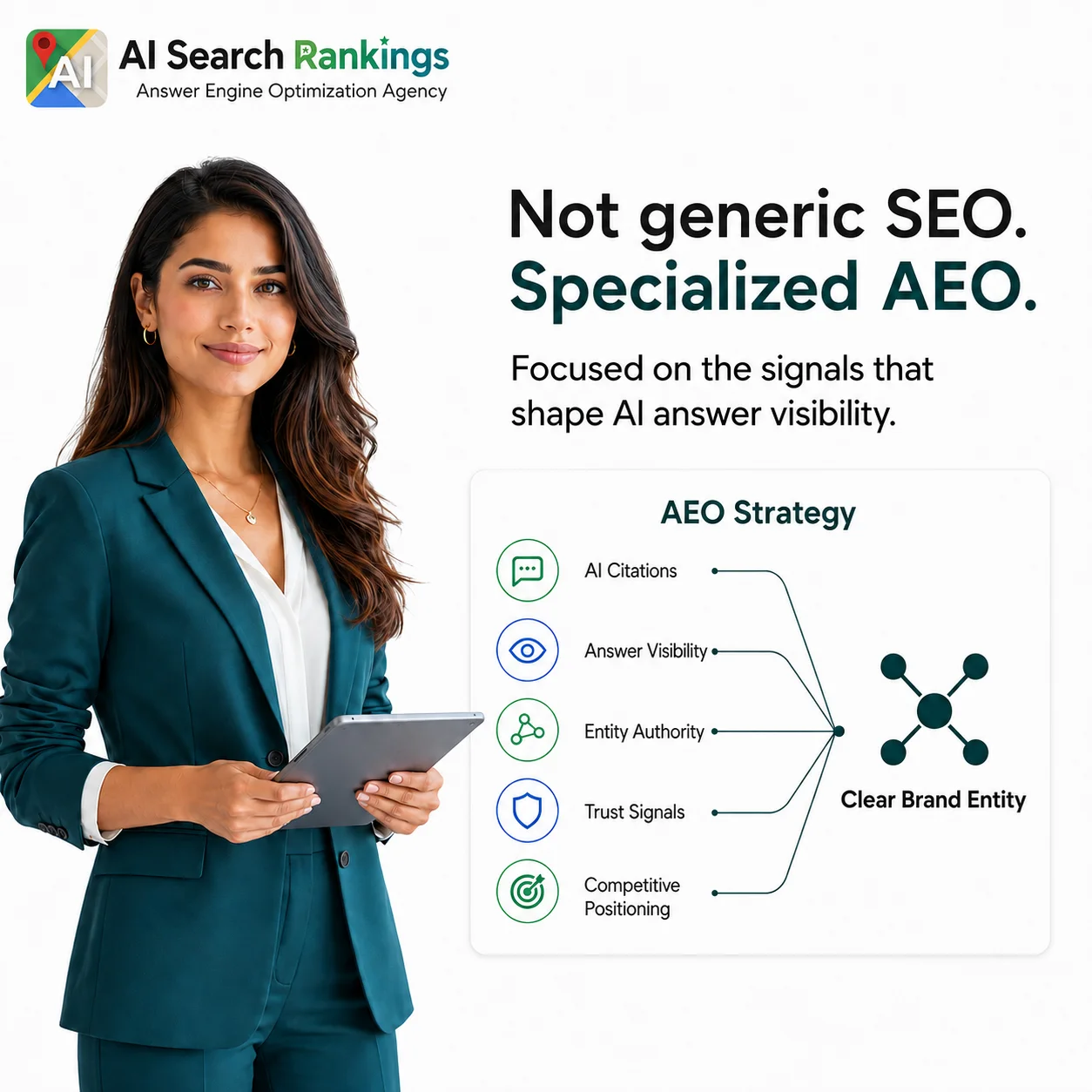
AI Search Rankings, an Answer Engine Optimization (AEO) agency, helps businesses become easier for AI search engines to find, understand, trust, cite, and recommend as the answer across platforms like ChatGPT, Google AI Overviews, Google Gemini, Google Maps, and search. NLP plays a critical role in this process by enabling AI systems to better understand the intent behind user queries and the semantic meaning of content.
By leveraging NLP principles, businesses can optimize their content to be more easily processed and understood by AI. This means creating clear, concise, and semantically rich content that directly answers user questions. Techniques such as named entity recognition help AI identify key entities in your content, while sentiment analysis can ensure your brand messaging is perceived positively. Ultimately, effective NLP strategies contribute directly to higher AI visibility and improved answer citations, making your business the trusted source.
Mistakes To Avoid
Common Mistakes To Avoid With Best Nlp Libraries for Python
Avoiding common implementation errors ensures your natural language processing projects deliver accurate insights without wasting resources.
Deploying heavy models for simple tasks
Teams often select the most advanced deep learning models because they represent the latest technology. They deploy massive transformer models for basic text classification or simple sentiment checks.
What it costs: This drives up cloud computing costs and slows down processing times without delivering noticeably better results.
The correction: Match the library to the complexity of the task by starting with lightweight tools like TextBlob before scaling to resource-heavy models.
Ignoring domain-specific vocabulary
Companies frequently deploy pre-trained models straight out of the box without fine-tuning them on their own industry data. They expect a general language model to understand highly technical medical, legal, or manufacturing terminology.
What it costs: The model misinterprets critical business terms, which leads to inaccurate insights and poor customer experiences.
The correction: Fine-tune your chosen NLP library on your specific internal documents and customer interactions to ensure accurate context.
Overlooking processing speed requirements
Decision-makers sometimes prioritize model accuracy over inference speed during the evaluation phase. They select highly accurate but slow libraries for real-time applications like live customer support chatbots.
What it costs: Customers experience long delays waiting for responses, which damages user satisfaction and increases support ticket abandonment.
The correction: Select speed-optimized libraries like SpaCy for real-time applications and reserve heavy transformer models for asynchronous background analysis.
Failing to plan for ongoing model maintenance
Businesses often treat NLP deployment as a single event. They launch a model and leave it running for months without updating its training data to reflect new products, trends, or customer behaviors.
What it costs: The model slowly degrades in accuracy as language and business contexts change, rendering its insights obsolete.
The correction: Establish a routine schedule to retrain your NLP models with fresh data to maintain high accuracy over time.
Common Questions
Frequently Asked Questions About Python NLP Libraries
What is the primary difference between NLTK and SpaCy?
NLTK is a more academic and research-oriented library, offering a wide array of algorithms and corpora for educational purposes and foundational tasks. SpaCy is designed for production use, prioritizing speed, efficiency, and ease of deployment with pre-trained models for common NLP tasks like named entity recognition and dependency parsing.
Which NLP library is best for deep learning tasks and large language models?
Hugging Face Transformers is a library for deep learning tasks and working with large language models such as BERT, GPT, and T5. It provides an extensive collection of pre-trained models, tools for fine-tuning, and a consistent API across different architectures, making it ideal for advanced AI applications.
Can I use multiple NLP libraries in a single project?
Yes, combining multiple NLP libraries in a single project is a common and effective strategy. Developers often use NLTK for specific preprocessing steps, SpaCy for core linguistic annotations, and Hugging Face Transformers for sophisticated language understanding or generation tasks. This approach allows you to use the unique strengths of each library.
How does NLP benefit marketing and business intelligence?
NLP significantly enhances marketing by enabling sentiment analysis of customer feedback, automating content creation, and personalizing customer interactions through chatbots. For business intelligence, NLP extracts critical insights from unstructured data like reports and emails, identifying trends, competitive intelligence, and operational efficiencies that drive informed decision-making.
Is SpaCy suitable for businesses with large data volumes?
SpaCy is highly suitable for businesses processing large data volumes due to its optimized performance and efficient architecture. It is written in Cython and uses optimized C implementations, making it one of the fastest NLP libraries for tasks like tokenization, parsing, and named entity recognition in production environments.
Your Next Step
What To Do Next With Best Nlp Libraries for Python
Moving from evaluating Python NLP libraries to implementing a successful AI strategy requires a clear plan of action. The next step is set out below, along with what happens after you take it.
Before you invest resources into custom models or complex infrastructure, you need to know exactly how AI search engines currently view your business data.
Request a Free AI Visibility Audit
What you receive: You receive an AI Answer Readiness Score that evaluates 47 specific readiness factors across your brand clarity, technical infrastructure, competitive positioning, and revenue impact.You submit your website URL and primary business details through our secure portal. Our team analyzes your current digital footprint to see how well AI engines understand and extract your information.
Schedule a Strategy Session
What you receive: You receive a customized roadmap detailing the exact steps needed to fix data gaps and structure your content for AI search engines.You meet with our Lead Answer Engine Optimization Strategist to review your audit results and discuss your specific business goals. We map out how structured data and clear entity definitions can improve your visibility in AI overviews.
Begin a 90-Day AEO Sprint
What you receive: You receive a fully optimized foundational presence that makes your business easier for AI search engines to find, understand, trust, cite, and recommend.You select an appropriate service tier, such as the Local AI Answer Starter package, to begin executing the strategy. Our team implements the necessary technical fixes, structures your data, and proves your entity authority to AI platforms.
Select the action below to begin. You will receive a written assessment of where your business currently appears in AI search, and the specific corrections that would change it.
Taking these steps ensures your business stops guessing about AI visibility and starts building a structured presence that language models can actually use.
Ready to Become the Answer AI Recommends?
Get a complete AI visibility audit and a custom Answer Engine Optimization roadmap built for your business, your market, and your revenue goals.
No contracts. Cancel any time. Results you can verify.
Verify Your AI Search Visibility
Discover how your brand is cited and recommended across ChatGPT, Google AI Overviews, and Gemini with our free site-level audit.
Get Free AI Visibility Audit