Key Takeaways
- AEO focuses on becoming a direct answer for AI search, while Traditional SEO aims for keyword rankings.
- AI search prioritizes structured data, semantic accuracy, and content that directly answers complex queries.
- Businesses must shift from broad keyword targeting to specific, authoritative answer provision to succeed in the AI era.
- Implementing AEO involves technical infrastructure, content structure, and demonstrating clear subject matter authority.
Understanding the Shift
What are the core differences between AEO and Traditional SEO?
Answer Engine Optimization (AEO) and Traditional Search Engine Optimization (SEO) both aim for online visibility, but their approaches and targets differ significantly due to the rise of AI in search.
Traditional SEO focuses on optimizing websites to rank high on search engine results pages (SERPs) for specific keywords. This has historically involved techniques like keyword density, link building, and content that appeals to Google's ranking algorithms. The goal is to drive clicks to your website.
Answer Engine Optimization (AEO) shifts this focus. It optimizes content to be directly cited, summarized, and recommended by AI-powered search engines and generative AI platforms. This means structuring content so AI models can easily find, understand, and trust your information to provide direct answers, often without sending the user to your website immediately. This approach seeks to establish your brand as an authority that AI systems can cite with confidence.
Foundational Practices
What is Traditional Search Engine Optimization (SEO)?
Traditional SEO encompasses strategies designed to improve a website's visibility in organic search results by ranking for keywords.
Traditional SEO centers on helping search engines like Google discover, crawl, and index web pages. Key elements include on-page optimization, such as optimizing title tags, meta descriptions, and header tags for target keywords. Technical SEO ensures the website is fast, mobile-friendly, and error-free, which aids search engine crawlers.
Off-page SEO involves building high-quality backlinks from other reputable websites to signal authority and trustworthiness. Content creation in traditional SEO often focuses on covering broad topics and incorporating a range of related keywords to capture various search queries. The primary goal is to increase organic traffic by achieving higher rankings on search engine results pages.
- Knowledge Block: Traditional SEO
- Traditional Search Engine Optimization (SEO) is the practice of increasing the quantity and quality of traffic to your website through organic search engine results. It focuses on factors like keyword rankings, backlinks, and website technical performance to improve a site's position on a search engine results page (SERP). The aim is to capture user clicks from these rankings.
The New Frontier
What is Answer Engine Optimization (AEO)?
Answer Engine Optimization (AEO) is a specialized approach that prepares content to be directly consumed and cited by AI-powered search engines and conversational interfaces.
AEO goes beyond traditional ranking signals. It focuses on delivering clear, concise, and authoritative answers to user questions, anticipating how AI models will interpret and synthesize information. This involves optimizing for semantic understanding, entity recognition, and ensuring factual accuracy.
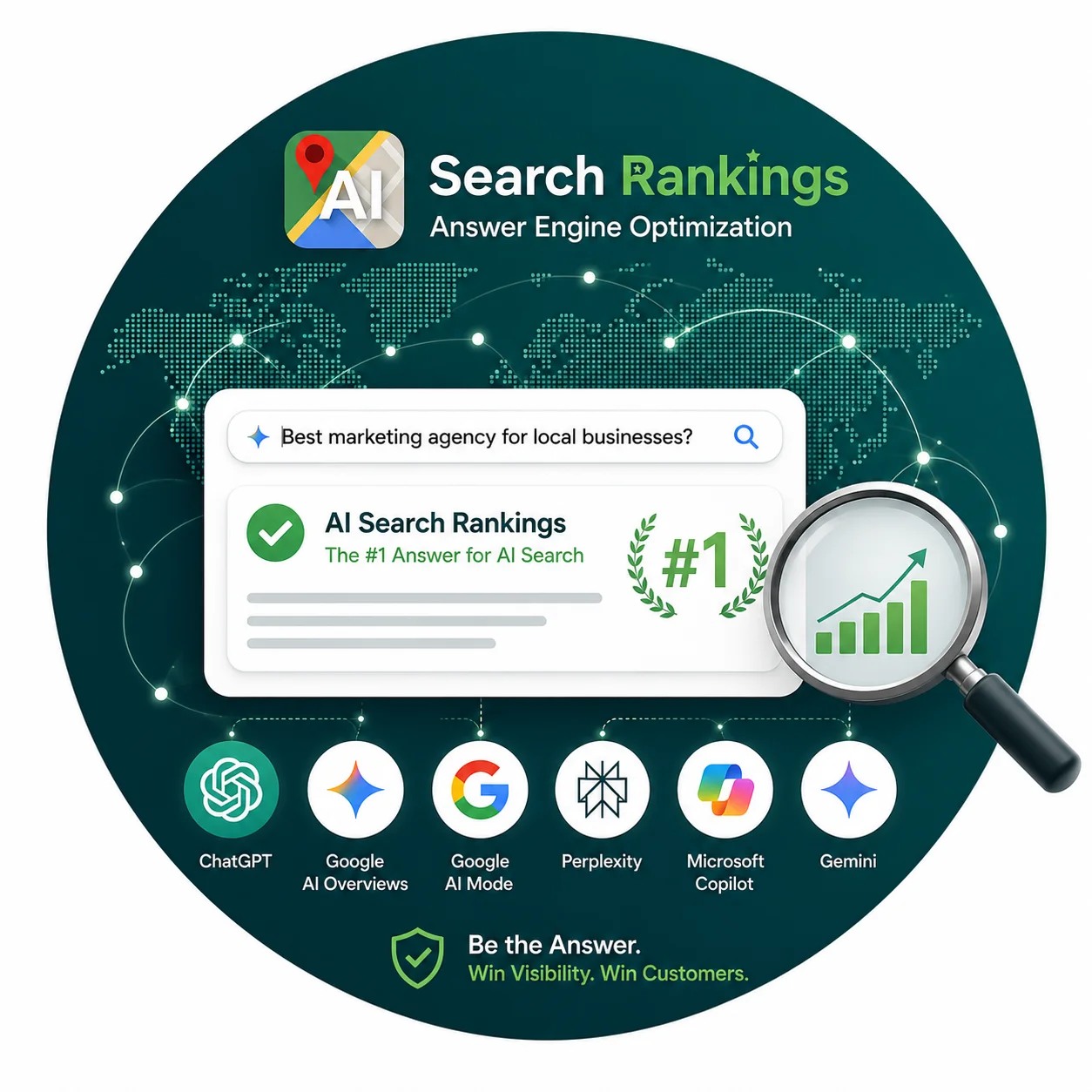
Key components of AEO include highly structured data (Schema.org markup), direct answers to common questions, and creating content that establishes clear expertise, experience, authority, and trustworthiness (E-E-A-T). For example, a business needs to ensure its unique selling propositions, service areas, and customer benefits are explicitly stated and easily digestible by AI. The goal is to be the trusted source that AI systems like Google AI Overviews, ChatGPT, and Google Gemini recommend.
- Knowledge Block: Answer Engine Optimization (AEO)
- Answer Engine Optimization (AEO) is a specialized form of digital marketing that prepares web content to be directly cited, summarized, and recommended by generative AI systems and AI-powered search interfaces. It emphasizes content clarity, semantic accuracy, comprehensive answering of specific queries, and robust authority signals to satisfy the needs of AI models. AEO aims to position a brand as the definitive source for AI-generated answers.
Honest Limitations
The Limitations To Know
This section outlines the boundaries of Answer Engine Optimization and the external factors that influence your results.
Where this does not help
- Third-party control over citation algorithms. Answer Engine Optimization prepares your content for AI systems, but the platform operators ultimately decide what to cite. Google and OpenAI constantly adjust their models without public notice. You cannot force an AI to select your answer over a competitor.
- The reality of zero-click interactions. When an AI system successfully answers a user question using your content, the user often has no reason to visit your website. This means your brand gains visibility and trust, but your traditional website traffic metrics may decrease. You must measure success through brand mentions and direct conversions rather than page views.
- Dependency on real-world brand authority. AI models look for established trust signals across the internet before they recommend a business. If your company lacks a digital footprint, customer reviews, or industry mentions, structuring your data will not be enough. Answer Engine Optimization requires a foundation of actual business credibility to work.
- Rapidly changing search interfaces. The layout and functionality of AI search tools change frequently. A specific answer format that triggers a citation today might disappear entirely next month. Your strategy must remain flexible because you do not control the user interface.
What remains within your control
- You control the accuracy, depth, and structure of the information you publish.
- You control how clearly your business, services, and service area are described.
- You control how quickly you correct an error once it is found.
- You control the evidence you provide behind every claim you make.
Strategic Comparison
AEO vs. Traditional SEO: Key Differences and Focus
| Feature | Traditional SEO | Answer Engine Optimization (AEO) |
|---|---|---|
| Primary Goal | Achieve high keyword rankings for increased website traffic. | Be directly cited and recommended by AI as the definitive answer. |
| Content Focus | Broad keyword coverage, blog posts, general articles. | Direct, concise, authoritative answers to specific questions; highly structured data. |
| User Interaction | Drives clicks to a website. | Provides direct answers in AI interfaces; may or may not drive clicks. |
| Technical Signals | Crawlability, indexability, page speed, mobile-friendliness. | Schema markup, entity recognition, factual accuracy, semantic clarity. |
| Authority Signals | Backlinks from high-authority domains, domain rating. | Demonstrable E-E-A-T (Expertise, Experience, Authority, Trustworthiness), citations, robust internal linking. |
| Measurement of Success | Organic traffic, keyword rankings, conversion rates from website visitors. | AI citation rate, direct answer visibility, brand mentions in AI summaries, conversion to direct actions. |
Evolving Strategies
Shifting Your Mindset: From Ranking to Answering
The Old Approach
Keyword Ranking Focus
The traditional mindset revolved around identifying keywords with high search volume and low competition. Content teams would then create pages designed to rank for those terms, often focusing on keyword variations and on-page optimization. The goal was to outrank competitors on the first page of Google, driving traffic through clicks. This approach often led to content that was optimized for machines rather than directly answering user intent.
The AEO Approach
Answer Provision Focus
The AEO mindset shifts to anticipating the exact questions users will ask, especially when engaging with AI conversational interfaces. It requires producing content that provides the most accurate, concise, and trustworthy answer. Instead of chasing broad keywords, you focus on semantic completeness and factual authority. This ensures that when an AI system searches for an answer, your content is the most suitable source to cite. The ultimate goal is to become the authoritative source AI recommends, building brand trust and direct engagement.
Strategic Imperatives
Why AEO is necessary for Modern Businesses
AEO helps businesses adapt to the changing search market, ensuring continued visibility and credibility with AI-powered search engines.
AI Visibility
AEO directly addresses how generative AI finds and uses information. Your content becomes easier for AI to discover and include in its summaries or recommendations, leading to increased brand presence in new search interfaces.
Enhanced Trust
When AI systems cite your business as a source, it builds significant trust and authority. This establishes your brand as an expert in your field, which is valuable for both AI users and traditional search users.
Improved User Experience
AEO-optimized content is clear, concise, and directly answers user questions. This provides a better experience for human users seeking immediate information, whether through AI summaries or direct website visits.
Future-Proofing Your Strategy
As AI continues to integrate more deeply into search, AEO ensures your digital strategy remains relevant. Adapting now positions your business to capture future opportunities and maintain a competitive edge in an evolving market.
Local Business Advantage
For local businesses, AEO is critical for AI to recommend services, operating hours, and locations in AI Overviews and Google Maps. Optimizing for local specific queries helps AI direct local users to your business.
Information Gain
AEO encourages creating content that offers unique insights, specific data, or proprietary frameworks. This type of valuable content is more likely to be prioritized and cited by AI systems looking for helpful and novel information.
Step-by-Step Process
How to Transition Your Strategy from SEO to AEO
Transitioning to AEO requires a structured approach to redefine content and technical foundations for AI search environments.
Conduct an AI Visibility Audit
Done when: You have a comprehensive report detailing your current AI presence, citation patterns, and AARS, identifying immediate opportunities.Evaluate your current online presence across various AI platforms and generative search experiences. Identify where your business appears, what information AI retrieves, and any gaps or inaccuracies. An AI Visibility Audit, such as the Free AI Visibility Audit from AI Search Rankings, will provide an AI Answer Readiness Score (AARS) by assessing 47 readiness factors across Brand Clarity, Technical Infrastructure, Competitive Positioning, and Revenue Impact.
Structure Content for Direct Answers
Done when: Your key service and product pages feature prominent, direct answers to likely AI queries, utilizing clear headings and summary sections.Rewrite or create new content that directly answers specific user questions in a clear, concise format. Use question-and-answer pairs, summary boxes, and well-defined headings. Prioritize factual accuracy and eliminate ambiguity. Ensure your unique value propositions and brand differentiators are explicitly stated for AI consumption.
Implement Robust Structured Data (Schema.org)
Done when: All relevant pages have accurate and validated Schema.org markup, enabling AI to understand your content's context and entities.Apply Schema.org markup extensively to your website content. This includes `LocalBusiness`, `Product`, `Service`, `FAQPage`, `HowTo`, and `Article` schema, among others. Structured data explicitly tells AI systems what your content means, enhancing their ability to extract and cite accurate information. Verify your schema implementation using Google's Rich Results Test.
Build E-E-A-T Signals
Done when: Your content consistently showcases clear authorship, verifiable credentials, and supports claims with strong, reputable sources, building a robust E-E-A-T profile.Demonstrate Expertise, Experience, Authority, and Trustworthiness. This means clearly identifying authors with relevant credentials, citing authoritative sources, maintaining up-to-date and accurate information, and securing endorsements or mentions from reputable industry sources. AI systems increasingly rely on strong E-E-A-T signals to determine content reliability.
Monitor AI Citation and Mentions
Done when: You have a system for tracking AI citations and can identify trends and opportunities for refining your AEO strategy.Regularly track how AI systems are citing and referencing your content. This involves monitoring AI Overviews, ChatGPT responses, and other generative AI outputs. Analyze these mentions to understand which types of content are most effective and identify areas for further optimization. Adjust your strategy based on these real-world AI interactions.
Expert Note
Focusing on long-tail, conversational queries naturally aligns with AEO. These are the precise questions users ask AI, and providing clear, structured answers for them can significantly boost your AI visibility and recommendation chances.
Ongoing Optimization
Overcoming Challenges in AEO Adoption
Adopting AEO presents specific challenges related to content creation, technical implementation, and measurement that businesses must address.
One primary challenge is the need for a shift in content strategy. Many businesses are accustomed to creating content for traditional keyword ranking, which often involves longer-form articles with broad topic coverage. AEO requires precise, direct answers, often necessitating a restructure of existing content or a new content creation pipeline focused on answering specific questions semantically. This demands a deeper understanding of user intent beyond simple keyword matching.
Another hurdle is the technical complexity of implementing advanced structured data. Correctly applying Schema.org markup across a large website can be challenging and requires technical expertise. Errors in schema can prevent AI systems from accurately interpreting content. also, measuring AEO success differs from traditional SEO metrics. Businesses need to track AI citations, direct answer placements, and brand mentions within AI summaries, rather than solely relying on organic traffic and keyword rankings. This requires new analytics tools and reporting frameworks.
Finally, the active nature of AI itself means that AEO strategies must be continuously adapted. AI models evolve, and how they process and present information can change. Therefore, an AEO strategy is not a one-time setup but an ongoing process of monitoring, testing, and refinement to remain effective.
How To Decide
How To Decide Which Approach Fits You
This section outlines specific business scenarios to help you choose between Answer Engine Optimization and Traditional SEO.
Your choice depends on how your target audience searches for your services and what type of content you currently produce. Review these common situations to determine the best path for your marketing budget.
If You operate a local business that depends on foot traffic or specific service areas.
Then Choose Answer Engine Optimization.
AI platforms like Google Gemini and AI Overviews prioritize structured local data and direct answers to recommend nearby businesses.
If You manage an e-commerce website with thousands of product pages relying on broad category searches.
Then Maintain a Traditional SEO approach.
Traditional SEO excels at ranking category pages for broad keywords where users prefer to click through and browse a visual catalog.
If You sell high-ticket consulting or specialized business services that require establishing authority.
Then Choose Answer Engine Optimization.
AEO structures your proprietary frameworks and expert insights so AI systems cite your firm as the definitive source for complex industry questions.
If Your revenue model depends entirely on maximizing page views and ad clicks across a wide variety of general topics.
Then Maintain a Traditional SEO approach.
Traditional SEO focuses on driving maximum click-through rates from search engine results pages to support impression-based revenue models.
Most modern businesses will eventually need a hybrid approach. However, identifying your primary revenue driver right now will dictate where you should allocate your immediate resources.
Mistakes To Avoid
Common Mistakes To Avoid
This section outlines the most frequent errors businesses make when shifting their focus from traditional search to AI-driven answers.
Many marketing teams apply old optimization habits to new AI platforms. This mismatch prevents generative engines from understanding and citing their content.
Burying the answer under long introductions
Marketing teams often write long, rambling introductions to keep readers on the page longer. They place the actual answer several paragraphs down to increase dwell time.
What it costs: AI models skip the content entirely because they cannot extract a concise, factual answer quickly.
The correction: State the direct answer in the first sentence of the section. Use the remaining paragraphs to provide context, examples, and proof.
Do not gate core business facts behind forms.
Companies frequently hide their pricing, specific service areas, and package details behind lead capture forms. They do this to force potential customers to contact sales.
What it costs: Generative AI cannot fill out forms. The engine concludes your business does not offer the service and recommends a competitor instead.
The correction: Publish clear, factual details about your capabilities, service areas, and baseline pricing directly on your public pages.
Relying on keyword density instead of semantic clarity
Writers sometimes repeat target phrases unnaturally throughout a page. They assume AI engines count keywords the same way early search algorithms did.
What it costs: The text becomes difficult to read and loses its semantic meaning. AI systems lower the trust score of the content and refuse to cite it.
The correction: Write naturally for a human reader. Use related concepts, synonyms, and clear definitions to build a complete semantic picture.
Publishing content without machine-readable context
Business owners often publish helpful answers on their blogs but fail to use Schema markup. They expect AI to understand the context based on the visible text alone.
What it costs: The AI engine lacks the structured data needed to verify the entity, the author, and the specific question being answered.
The correction: Implement robust structured data that explicitly defines your organization, the author credentials, and the exact questions your page resolves.
Avoiding these errors ensures your technical foundation and content structure align with how AI actually processes information.
Common Questions
AEO and Traditional SEO Frequently Asked Questions
Do I still need Traditional SEO if I focus on AEO?
Yes, Traditional SEO remains important. AEO builds upon a strong SEO foundation. Core SEO elements like technical health, site speed, mobile-friendliness, and a logical site structure are still critical for both human users and AI systems to access and understand your content effectively. AEO is an evolution, not a replacement.
How long does it take to see AEO results?
AEO results can vary, but initial improvements in AI visibility and citation can be seen within a few weeks to months, especially with well-structured data and direct answers. Comprehensive AEO, like any advanced optimization strategy, requires sustained effort for long-term authority and trust building. Continuous monitoring and adaptation are key.
Can small businesses benefit from AEO?
Absolutely. Small and local businesses can gain a significant competitive advantage through AEO. By clearly providing answers to local service queries or specific product questions, they can be recommended by AI systems for relevant local searches. This direct recommendation can drive highly qualified leads and build local authority, often bypassing larger competitors.
What is the AI Answer Readiness Score (AARS)?
The AI Answer Readiness Score (AARS) is a proprietary diagnostic framework used by AI Search Rankings. It evaluates 47 readiness factors across four pillars: Brand Clarity, Technical Infrastructure, Competitive Positioning, and Revenue Impact. This score helps businesses understand their current state of AI visibility and identifies key areas for AEO improvement.
Your Next Step
What To Do Next
This section outlines the exact steps you can take right now to measure and improve your brand visibility in AI search engines. The next step is set out below, along with what happens after you take it.
Transitioning from traditional SEO to Answer Engine Optimization begins with understanding your current baseline. Our engagement path is designed to find your gaps and build a structured plan to fix them.
Request your Free AI Visibility Audit
What you receive: You receive a confirmation email scheduling the delivery of your audit results.You submit your website and primary business details through our secure form at /ai-audit/. Our team analyzes your current digital footprint across major AI platforms to see where your brand appears and where it is missing.
Review your AI Answer Readiness Score
What you receive: You receive a detailed report showing your baseline score and specific technical gaps.We evaluate your website against 47 distinct readiness factors across Brand Clarity, Technical Infrastructure, Competitive Positioning, and Revenue Impact. This evaluation reveals exactly how AI search engines currently view and trust your business data.
Attend your Strategy Session
What you receive: You receive a clear, customized roadmap for your transition from traditional SEO to an AI-first content structure.You meet directly with our Answer Engine Optimization team to discuss the findings of your audit. We explain the technical roadblocks preventing AI from citing your business and outline the exact corrections required.
Launch your 90-Day AEO Sprint
What you receive: You receive a fully optimized technical foundation and monthly monitoring to track your AI citation growth.We implement the Local Answer System to find, fix, structure, and prove your business facts across the web. This sprint focuses on deploying robust Schema.org markup and restructuring your content to deliver direct answers.
Select the action below to begin. You will receive a written assessment of where your business currently appears in AI search, and the specific corrections that would change it.
Ready to Become the Answer AI Recommends?
Get a complete AI visibility audit and a custom Answer Engine Optimization roadmap built for your business, your market, and your revenue goals.
No contracts. Cancel any time. Results you can verify.
Verify Your AI Search Visibility
Discover how your brand is cited and recommended across ChatGPT, Google AI Overviews, and Gemini with our free site-level audit.
Get Free AI Visibility Audit