AEO vs Traditional SEO: Guiding Business Growth in AI Search
Businesses must understand the shift from traditional keyword-based search to AI-driven answer engines. This guide explains how Answer Engine Optimization (AEO) and Traditional SEO differ and which approach secures future digital visibility and growth.
The way people find information online is changing. Traditional SEO focused on making websites rank high in organic search results for specific keywords. Today, AI search engines and large language models provide direct answers to complex questions, often summarizing information without a direct click to a website. This new reality requires a new strategy: Answer Engine Optimization (AEO).
Key Takeaways
- AEO optimizes content to be directly cited and recommended by AI search engines, focusing on clarity and authority for answer generation.
- Traditional SEO aims for top organic search result rankings by optimizing for keywords and backlinks.
- The primary goal of AEO is to satisfy user intent with complete, authoritative answers, reducing the need for users to visit multiple sources.
- Businesses need both strategies, but AEO addresses the new behavior of AI systems and their users.
- Knowledge Block: Answer Engine Optimization (AEO)
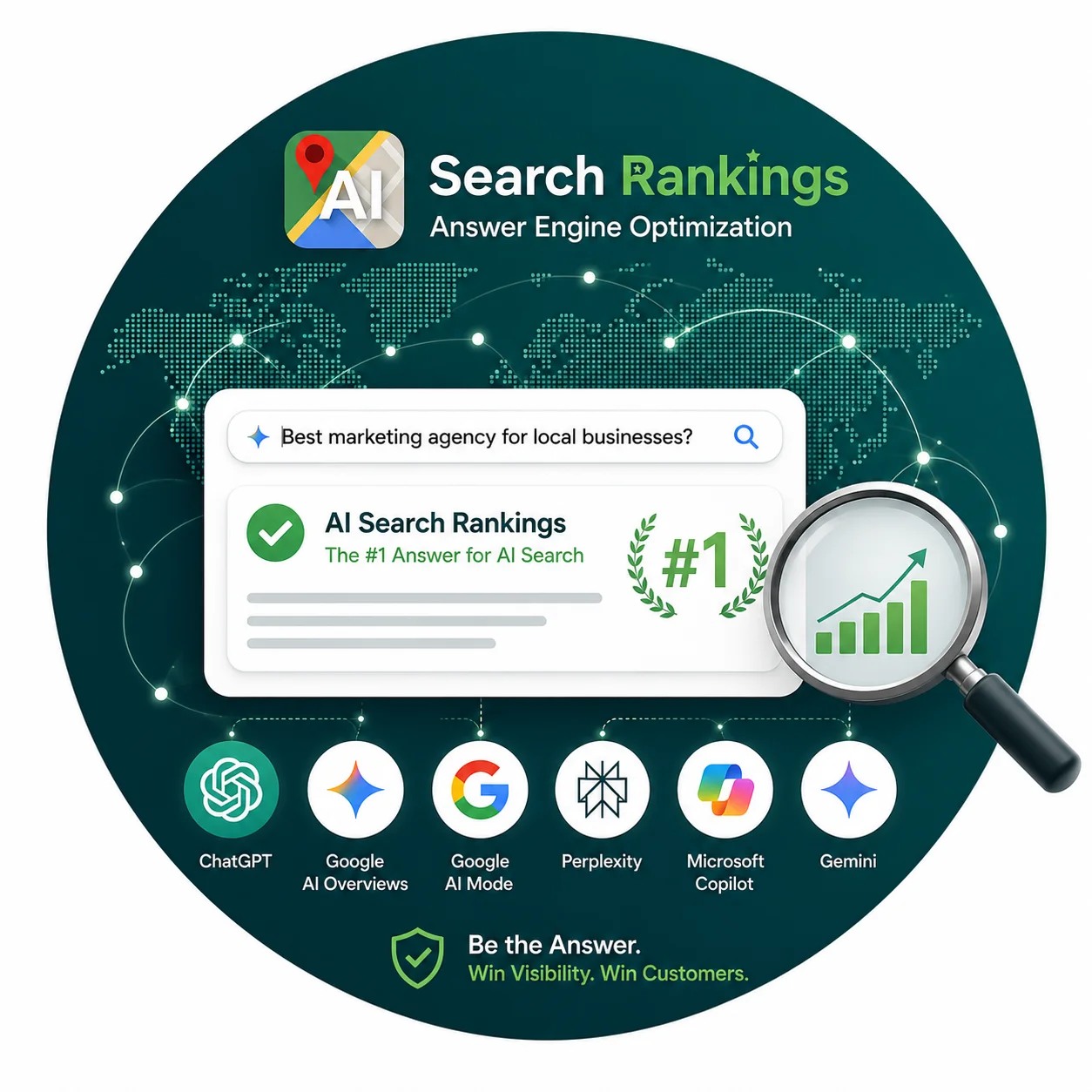
- Answer Engine Optimization (AEO) is the process of optimizing digital content and online presence to be easily found, understood, trusted, cited, and recommended by AI search engines and large language models like ChatGPT, Google AI Overviews, and Google Gemini. AEO focuses on providing clear, concise, and authoritative answers to user queries, ensuring that AI systems can directly extract and present accurate information from a business's content. This strategy aims to position a business as the definitive answer source, not just a ranked link.
Understanding AEO
What is Answer Engine Optimization?
AEO focuses on preparing your content to be consumed and re-shared by AI, making your business the trusted source for direct answers.
Answer Engine Optimization is a forward-looking approach that adapts digital strategy for the AI-first search environment. Instead of solely chasing keyword rankings, AEO structures content to directly answer user questions with clarity, authority, and completeness. This means organizing information logically, using clear language, and providing verifiable facts that AI models can readily process and cite. AEO ensures your business is understood as a credible source across emerging platforms like Google AI Overviews and ChatGPT.
The goal is to move beyond simply appearing in search results. AEO aims to make your business the actual answer, cited by AI systems when users ask questions relevant to your products or services. This builds significant brand trust and visibility, often bypassing the traditional organic search results page.
Understanding Traditional SEO
What is Traditional Search Engine Optimization?
Traditional SEO optimizes websites to rank higher in conventional search engine results pages for specific keywords.
Traditional SEO, or Search Engine Optimization, has historically focused on improving a website's visibility for relevant search terms. This involves a range of tactics including keyword research, on-page optimization, technical SEO, content creation, and building high-quality backlinks. The primary objective is to drive organic traffic to a website by achieving top rankings in Google's traditional ten blue links or featured snippets.
While still valuable for certain types of queries and user behaviors, traditional SEO's impact is diminishing as AI overviews summarize answers directly. A strong traditional SEO foundation remains important for a website's overall health and discoverability, but it no longer fully captures the opportunities in the evolving search market. It primarily targets human users navigating search results, rather than AI systems extracting answers.
Key Strategic Differences
AEO vs. Traditional SEO: A Direct Comparison
Understanding these core differences helps businesses choose the right strategies for future digital visibility.
| Feature | Traditional SEO | Answer Engine Optimization (AEO) |
|---|---|---|
| Primary Goal | Rank for keywords, drive clicks to website. | Be cited as the direct answer by AI, build AI trust. |
| Target Audience | Human users browsing search results. | AI models, large language models, and human users seeking direct answers. |
| Content Focus | Keyword density, content length, internal/external links. | Clarity, conciseness, factual accuracy, direct answer formatting, entity relationships. |
| Technical Aspects | Crawlability, indexability, page speed, mobile-friendliness. | Structured data (Schema.org), entity graphs, knowledge panel optimization, E-E-A-T signals. |
| Success Metrics | Organic traffic, keyword rankings, conversion rates from clicks. | AI citation volume, direct answer placements, brand mention analysis, AARS score improvement. |
| User Interaction | Clicking through to website for full information. | Receiving direct answers from AI systems, conversational search experiences. |
Future-Proofing Your Business
Why Businesses Need Answer Engine Optimization Now
AEO helps businesses stay relevant and visible in a search market increasingly dominated by AI conversational interfaces.
Direct AI Citations
AEO positions your content to be directly quoted and recommended by AI, driving trust and authority without requiring a website click. This ensures your brand is the source of truth.
Expanded Visibility
Beyond traditional search results, AEO extends your reach into AI Overviews, ChatGPT, Google Gemini, and voice search. This broadens your discoverability across new user interfaces.
Enhanced Trust & Authority
When AI systems cite your business, it signals high authority and trustworthiness to users. This validation strengthens your brand's credibility in the market.
Anticipate User Intent
AEO focuses on understanding and satisfying the full intent behind complex questions, providing comprehensive answers that meet user needs directly. This improves user experience.
Local Search Advantage
For local businesses, AEO is vital for appearing in AI-powered local recommendations and Google Maps results. It helps local AI search results accurately recommend your services.
Competitive Edge
Early adoption of AEO allows businesses to capture market share before competitors fully adapt. This proactive approach secures your position as an industry leader.
Evolving Search Paradigms
The Evolution of Search: From Keywords to Answers
The shift from traditional keyword matching to AI-powered answer generation represents a fundamental change in how users find information.
The Keyword Era
Limitations of Keyword-Focused Optimization
In the keyword era, search was primarily a matching game. Users typed specific keywords, and search engines returned documents containing those keywords. The limitation was that search engines often struggled with complex, conversational queries or understanding the true intent behind vague keywords. Businesses optimized for exact match terms, leading to content that sometimes felt unnatural or repetitive. This approach could miss broader user needs or nuanced questions that did not fit a simple keyword phrase. Content often prioritized ranking over genuinely satisfying user intent without a click.
The Answer Era
Opportunities in AI-Powered Answer Generation
The answer era uses advanced AI and machine learning to understand the meaning and intent behind queries, even conversational ones. AI systems provide direct answers, summarize information, and engage in dialogue. This creates opportunities for businesses to become authoritative sources of information, not just listed websites. By structuring content to directly answer questions and demonstrate expertise, businesses can earn citations from AI. This approach ensures content is helpful and useful, building trust with both human users and AI systems. It aligns with Google's People-First content guidelines.
- Knowledge Block: E-E-A-T in AEO
- E-E-A-T stands for Experience, Expertise, Authoritativeness, and Trustworthiness. In AEO, E-E-A-T signals are paramount. AI search engines heavily rely on these factors to determine which sources are credible enough to cite directly. Businesses must demonstrate real-world experience, deep subject matter expertise, established authority in their niche, and unquestionable trustworthiness through transparent data, verifiable facts, and strong online reputation. This goes beyond simple SEO signals and demands a comprehensive approach to brand perception and content quality.
Our AEO Methodology
How AI Search Rankings Implements AEO for Your Business
AI Search Rankings uses a structured six-stage process to transform your digital presence into an AI-ready answer engine.
-
Find: Conduct an AI Visibility Audit
Done when: You receive a comprehensive AARS report detailing your current AI search standing and areas for improvement.We start with a Free AI Visibility Audit to evaluate your current online presence across 47 readiness factors. This assessment generates your AI Answer Readiness Score (AARS) across Brand Clarity, Technical Infrastructure, Competitive Positioning, and Revenue Impact. It identifies where your business currently appears or fails to appear in AI search results.
-
Fix: Optimize Technical & Content Foundations
Done when: Your website's technical foundation supports AI crawling and your core content provides clear, direct answers to target questions.We address technical gaps that hinder AI discoverability, such as incomplete structured data, unclear entity relationships, or conflicting information. We also refine existing content for clarity, conciseness, and E-E-A-T signals, ensuring it directly answers common queries.
-
Structure: Build an AI-Ready Knowledge Base
Done when: Your key business entities are clearly defined with structured data, enhancing AI comprehension and citation potential.We organize your information into a structured knowledge base, using schema markup and entity optimization to help AI systems understand your business, products, and services. This creates an interconnected web of authoritative information.
-
Prove: Establish Authority & Trust Signals
Done when: Your digital footprint consistently signals high E-E-A-T to AI systems, increasing citation likelihood.We implement strategies to demonstrate your business's experience, expertise, authoritativeness, and trustworthiness. This includes content creation showcasing deep industry knowledge, securing authoritative external links, and managing online reputation. This step makes your business a reliable source for AI.
-
Track: Monitor AI Visibility & Performance
Done when: You receive regular reports on your AI visibility, showing direct citation growth and impact on brand awareness.We continuously monitor your business's presence in AI search results, tracking direct citations, brand mentions, and shifts in conversational search performance. This helps us adapt strategies quickly to AI model updates and user behavior changes.
-
Grow: Scale Your Answer Engine Strategy
Done when: Your AEO strategy consistently drives increased AI visibility, brand authority, and contributes to business growth targets.Based on performance data and emerging AI trends, we refine and expand your AEO strategy. This includes identifying new topics for AI-optimized content, exploring additional AI platforms, and integrating AEO with broader marketing efforts to drive sustainable business growth.
Strategic Considerations
Challenges and Considerations for AEO Adoption
Implementing AEO requires addressing specific challenges to achieve successful AI search visibility.
Advantages of Adopting AEO
- Increased brand visibility in AI Overviews and conversational interfaces.
- Enhanced brand authority and trust when cited as a direct answer by AI.
- Future-proofs marketing efforts against evolving search trends.
- Potential for higher quality leads from users whose complex questions are directly answered.
- Improved user experience by providing immediate, comprehensive answers.
Limitations to Consider
- Requires a significant shift in content strategy, focusing on answers over keywords.
- Measuring direct citation impact can be more complex than traditional traffic metrics.
- Requires deep understanding of AI model behaviors and structured data implementation.
- Initial investment in content restructuring and technical optimization may be substantial.
- Constant adaptation is necessary due to rapid changes in AI technologies.
Strategic Insights
The AI Answer Readiness Score (AARS) Framework
The AARS provides a structured evaluation to determine your business's preparedness for AI search.
Comprehensive AARS Evaluation
The AI Answer Readiness Score (AARS) assesses 47 distinct readiness factors across four critical pillars. These pillars are Brand Clarity, Technical Infrastructure, Competitive Positioning, and Revenue Impact. This holistic framework ensures every aspect of your digital footprint is optimized for AI search engines, identifying specific strengths and weaknesses to guide strategic AEO efforts.
Actionable Insights
Each AARS report provides actionable recommendations. Businesses receive a clear roadmap to improve their AI visibility and become a trusted AI answer source.
Mistakes To Avoid
Common Mistakes To Avoid
Avoiding common strategic errors ensures your transition from traditional search tactics to answer engine optimization is effective.
Treating AI Overviews like traditional search snippets
Marketing teams often write content packed with exact keyword phrases to capture traditional featured snippets. They assume AI models extract text exactly like older search crawlers do. This leads to unnatural phrasing that prioritizes search terms over clear facts.
What it costs: Answer engines ignore the content because it lacks the natural language and factual density required for a direct citation.
The correction: Write direct and factual answers using plain language that clearly defines the subject.
Burying direct answers deep inside long articles
Content creators frequently place the actual answer at the bottom of a long page to keep visitors scrolling. They prioritize time on page over immediate clarity. The core facts get lost in unnecessary background information.
What it costs: AI systems fail to find the answer quickly and choose a competitor who provides the information upfront.
The correction: Place the direct answer in the first two sentences of the section before providing the supporting context.
Ignoring technical entity structure
Website owners often publish strong content but fail to connect the underlying concepts using structured data. They rely entirely on the visible text to explain who they are and what they do. This leaves the technical foundation incomplete.
What it costs: AI systems struggle to verify the business identity and relationships, which lowers the trust required for a recommendation.
The correction: Implement accurate structured data to define the primary entities, organization details, and factual claims on the page.
Measuring answer engine success with traditional traffic metrics
Directors often evaluate their answer engine strategy by looking solely at website traffic and clicks. They expect AI citations to behave exactly like traditional organic links. This creates a mismatch between the strategy and the reporting.
What it costs: Leadership abandons successful campaigns prematurely because they misinterpret a drop in early website clicks as a failure.
The correction: Track AI citation volume, brand mentions, and your AI Answer Readiness Score to measure true visibility.
Publishing generic summaries without verifiable proof
Businesses sometimes publish broad summary articles written by generalists without citing direct experience or authoritative sources. They treat content production as a volume metric rather than a trust signal. The resulting pages look identical to hundreds of other websites.
What it costs: Large language models filter out the content as unverified or low quality, preventing the brand from building authority.
The correction: Include specific examples, original data, and clear author credentials that prove direct experience with the topic.
Common Questions
AEO and Traditional SEO Frequently Asked Questions
Can AEO replace Traditional SEO entirely?
No, AEO cannot replace Traditional SEO entirely. Traditional SEO builds the fundamental technical and content health of your website, making it discoverable by search engines. AEO then optimizes this foundation for AI systems, positioning your business as an authoritative answer source. Both strategies are complementary and necessary for comprehensive digital visibility.
How does AEO benefit local businesses specifically?
AEO helps local businesses by ensuring their information is easily extractable and trusted by AI systems for local queries. This means appearing in Google AI Overviews for local searches, Google Maps recommendations, and voice search results. AEO optimizes local service details, operating hours, and customer reviews to be clearly understood and cited by AI, driving direct local leads.
What is the AI Answer Readiness Score (AARS)?
The AI Answer Readiness Score (AARS) is a proprietary diagnostic framework developed by AI Search Rankings. It evaluates 47 readiness factors across four pillars: Brand Clarity, Technical Infrastructure, Competitive Positioning, and Revenue Impact. The AARS provides a quantifiable measure of a business's preparedness to be recognized and cited by AI search engines.
How long does it take to see AEO results?
The timeline for AEO results varies based on factors like current digital presence, industry competition, and the scope of optimization. Initial improvements in AI visibility and citation likelihood can often be seen within a 90-Day AEO Sprint. Sustainable authority and consistent AI recommendations are built over several months of ongoing optimization and monitoring.
Your Next Step
What To Do Next
These are the exact steps you take to transition your business from traditional search rankings to direct AI citations. The next step is set out below, along with what happens after you take it.
Request your Free AI Visibility Audit
What you receive: You receive a comprehensive baseline report detailing exactly how Google AI Overviews and ChatGPT currently view your brand.You submit your website URL and primary business details through our secure portal. We analyze your current digital footprint against the 47 readiness factors of the AI Answer Readiness Score framework.
Schedule a dedicated Strategy Session
What you receive: You walk away with a clear understanding of your competitive positioning and the exact steps required to improve your visibility.We review your audit results together on a focused call. We identify the specific technical gaps and content opportunities that prevent AI search engines from citing your business.
Launch your 90-Day AEO Sprint
What you receive: Your business transitions from a traditional website into a structured entity that AI search engines can confidently recommend as the definitive answer.We implement the Local Answer System to fix your technical infrastructure and structure your knowledge base. This focused execution phase builds the exact entity relationships and trust signals that AI models require.
Select the action below to begin. You will receive a written assessment of where your business currently appears in AI search, and the specific corrections that would change it.
Ready to Become the Answer AI Recommends?
Get a complete AI visibility audit and a custom Answer Engine Optimization roadmap built for your business, your market, and your revenue goals.
No contracts. Cancel any time. Results you can verify.
Verify Your AI Search Visibility
Discover how your brand is cited and recommended across ChatGPT, Google AI Overviews, and Gemini with our free site-level audit.
Get Free AI Visibility Audit