Understanding AI Search
What Is Answer Engine Optimization (AEO)?
Answer Engine Optimization, or AEO, is the method of making your business content clear and credible for AI search engines, ensuring they recommend you directly to users. This guide explains how AEO works and why it is critical for business visibility today.
In a world where people ask questions directly to AI assistants and get immediate answers, your business needs to be the answer. Answer Engine Optimization (AEO) is a specialized strategy designed for this new reality. It moves beyond traditional keyword ranking to focus on optimizing your content to satisfy direct user questions and the precise data needs of AI models.
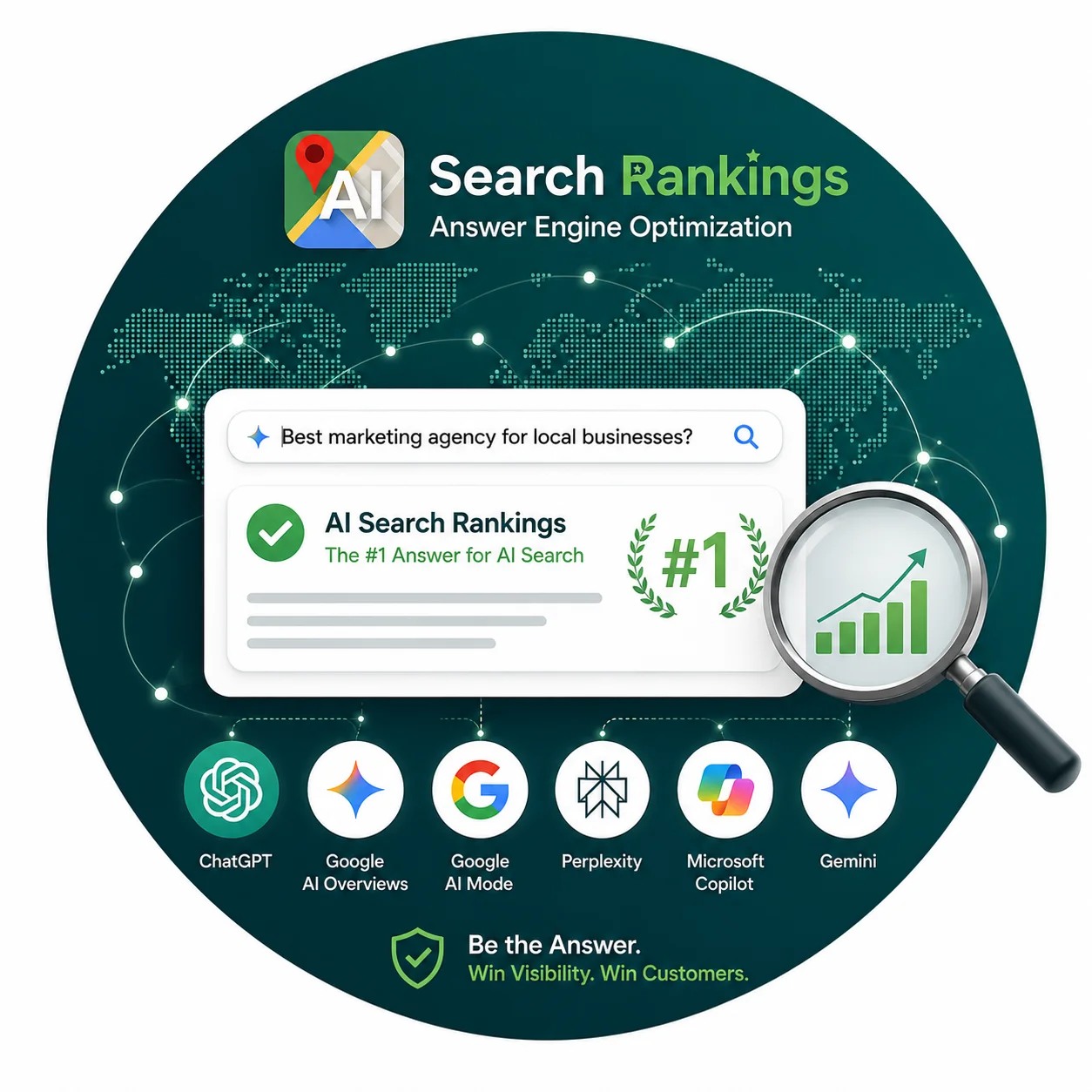
AI Search Rankings is an Answer Engine Optimization (AEO) agency that helps businesses become easier for AI search engines to find, understand, trust, cite, and recommend as the answer across ChatGPT, Google AI Overviews, Google Gemini, Google Maps, and search. We understand that AI does not just present a list of links. It provides definitive answers. Your goal is to become that definitive answer.
Key Takeaways
- Answer Engine Optimization (AEO) focuses on getting your content directly cited by AI search engines and conversational AI systems.
- AEO strategies prioritize semantic clarity, factual accuracy, and structured data to meet AI's specific information needs.
- Unlike traditional SEO, AEO aims for direct answers and AI recommendations, not just higher link rankings.
- Businesses must adapt their content to an AI-first indexing approach to maintain visibility in the evolving search market.
Core Concept
What Exactly is Answer Engine Optimization?
AEO is the practice of structuring and enriching your content so AI systems can easily extract, understand, and use it to directly answer user queries, making your business a primary source.
Answer Engine Optimization (AEO) is a specialized field that ensures your online content is optimized for AI-driven search experiences. This means going beyond traditional keyword placement. AEO focuses on explicit factual statements, clear definitions, and comprehensive answers to specific questions that users might ask conversational AI systems. This includes platforms like Google AI Overviews, Google Gemini, ChatGPT, Microsoft Copilot, and Perplexity AI.
The goal of AEO is not simply to rank high in a list of ten blue links. Instead, it aims for your business to be the source that an AI system cites when providing a direct answer to a user. This shift requires a deep understanding of natural language processing, semantic relationships, and the specific data requirements of large language models.
- Knowledge Block: Answer Engine Optimization (AEO)
- Answer Engine Optimization (AEO) is a digital marketing strategy focused on optimizing online content to be understood, trusted, and directly utilized by artificial intelligence systems. The objective is for a business's content to be cited, summarized, or recommended as the definitive answer by AI-powered search engines and conversational interfaces, providing direct value to users and establishing authoritative visibility.
The Paradigm Shift
Why AEO Matters Now: From Links to Direct Answers
AI search engines are changing how users find information, prioritizing direct, summarized answers over traditional link lists, making AEO necessary for future visibility.
For decades, search engine optimization (SEO) focused on securing top positions in Google's ten blue links. Users would click these links to find their answers. Today, that model is rapidly evolving. Google AI Overviews, for example, often provide a direct answer at the top of the search results page, citing sources in the process. ChatGPT and Gemini offer conversational responses that synthesize information from various online sources.
This means if your content is not optimized for AI, you risk becoming invisible. A business might rank well for a traditional keyword, yet still be overlooked by AI systems if its content is not structured for easy extraction and validation. AEO addresses this by preparing your content to be consumed directly by these AI models, increasing your chances of being cited as the authoritative answer.

Honest Limitations
The Limitations To Know
This section outlines the boundaries of Answer Engine Optimization and the factors that remain outside your direct control.
Where this does not help
- AI Model Selection Algorithms Answer Engine Optimization cannot force an AI platform to choose your business as the single answer. The final citation depends entirely on the proprietary algorithms used by systems like ChatGPT and Google Gemini. These platforms control how they weigh trust signals and select sources.
- Training Data Cutoffs and Indexing Delays Updates to your website do not appear in AI answers instantly. Visibility depends on when the AI model crawls your site and updates its training data. You cannot control the refresh schedules of third party language models.
- Subjective and Opinion-Based Queries Artificial intelligence systems rarely cite a single business for questions that require subjective opinions or creative advice. AEO depends on factual clarity and objective data to secure citations. If a user asks for a personal recommendation, the AI will likely synthesize a general response instead of pointing to your specific brand.
- Foundational Brand Reputation Structuring your data perfectly will not overcome a poor real-world reputation. AI models depend on external trust signals like customer reviews and established digital authority. You cannot use technical optimization to bypass the need for genuine business credibility.
What remains within your control
- You control the accuracy, depth, and structure of the information you publish.
- You control how clearly your business, services, and service area are described.
- You control how quickly you correct an error once it is found.
- You control the evidence you provide behind every claim you make.
Strategic Comparison
How Does AEO Differ from Traditional SEO?
While SEO and AEO both aim for online visibility, AEO specifically targets AI's comprehension and citation requirements, shifting focus from ranking links to becoming the definitive answer.
| Factor | Traditional SEO | Answer Engine Optimization (AEO) |
|---|---|---|
| Primary Goal | Achieve high rankings in organic search results (blue links). | Be directly cited, summarized, or recommended by AI search engines. |
| Content Focus | Keyword density, content length, broad topical coverage. | Factual accuracy, semantic clarity, direct answers to questions, structured data. |
| Audience Interaction | Clicking a link to visit a webpage for information. | Receiving a direct, summarized answer from an AI system, with your site cited as the source. |
| Technical Optimization | Crawlability, indexability, site speed, mobile-friendliness. | Schema markup, entity relationships, knowledge graph integration, data validation. |
| Authority Signals | Backlinks, domain authority. | E-E-A-T (Experience, Expertise, Authoritativeness, Trustworthiness), factual corroboration, primary sourcing. |
Expert Note
While AEO is distinct from SEO, it does not replace it. Strong technical SEO and relevant content remain foundational. AEO builds upon these fundamentals, adding specialized layers of optimization for AI systems.
Core Strategies
The Pillars of Effective Answer Engine Optimization
Effective AEO relies on four key pillars that ensure your content is not only visible but also credible and useful to AI search engines.
Brand Clarity
AI systems must understand what your business offers, its unique value, and its core identity. This involves consistent branding, clear value propositions, and a unified message across all digital touchpoints.
Technical Infrastructure
Your website's technical foundation must be robust, allowing AI crawlers to access, parse, and understand your content efficiently. This includes clean code, fast loading times, and mobile responsiveness.
Competitive Positioning
Understanding how your competitors appear in AI search allows you to identify gaps and opportunities. This means analyzing their AI citations and tailoring your strategy to offer unique, authoritative answers.
Revenue Impact
AEO efforts must tie directly to business outcomes. By optimizing for specific questions related to your services or products, you can drive qualified traffic and generate measurable revenue growth.
Factual Authority
AI systems prioritize trustworthy information. Establishing factual authority requires clear citations, expert authors, and consistent, verifiable data. This builds the credibility AI needs to cite you.
Semantic Clarity
Content needs to be semantically rich, meaning it uses precise language that clearly defines entities and relationships. This helps AI understand the nuances of your industry and specific offerings.
Methodology
Implementing AEO: The Local Answer System
AI Search Rankings uses a six-stage Local Answer System to help businesses systematically optimize for AI search and become the recommended answer.
-
Find Your Current AI Visibility
Done when: You have a clear understanding of your current AI visibility and key areas for improvement, often determined through an AI Visibility Audit.Identify where your business currently appears, or fails to appear, in AI search results across platforms like Google AI Overviews, ChatGPT, and Google Maps. This initial audit provides a baseline for your AEO strategy.
-
Fix Foundational Technical Issues
Done when: Your website's technical health score has improved, and critical AI indexing barriers are removed.Address technical website problems that hinder AI crawlers from accessing and understanding your content. This includes core web vitals, mobile responsiveness, and clean code structure, ensuring AI can parse your site effectively.
-
Structure Content for AI Comprehension
Done when: Key pages on your site have robust, valid schema markup that accurately reflects your business information and services.Reformat and enrich your content using schema markup (structured data) to explicitly define entities, attributes, and relationships. This helps AI systems instantly grasp the meaning and context of your information.
-
Prove Expertise and Trustworthiness
Done when: Your content explicitly demonstrates high E-E-A-T signals, making your brand a credible source for AI systems.Build your brand's Experience, Expertise, Authoritativeness, and Trustworthiness (E-E-A-T) by showcasing credentials, client success stories, and accurate, verifiable information. AI prioritizes trusted sources when providing answers.
-
Track AI Answer Performance
Done when: You have a clear reporting system showing your AI citation rates and direct answer visibility metrics.Monitor your performance in AI search results, identifying which queries your content answers, how often it is cited, and its overall impact on visibility and traffic. Adjust your strategy based on these insights.
-
Grow Your AI Answer Authority
Done when: Your business consistently appears as an authoritative answer across a growing number of relevant AI search queries.Continuously expand your content to cover new user questions and evolving AI capabilities. Cultivate a strong online presence that consistently reinforces your authority and relevance as an answer source.
Measurement and Evaluation
Measuring Your AEO Success: The AI Answer Readiness Score
The AI Answer Readiness Score (AARS) provides a comprehensive evaluation of your business's preparedness for AI search, guiding your optimization efforts.
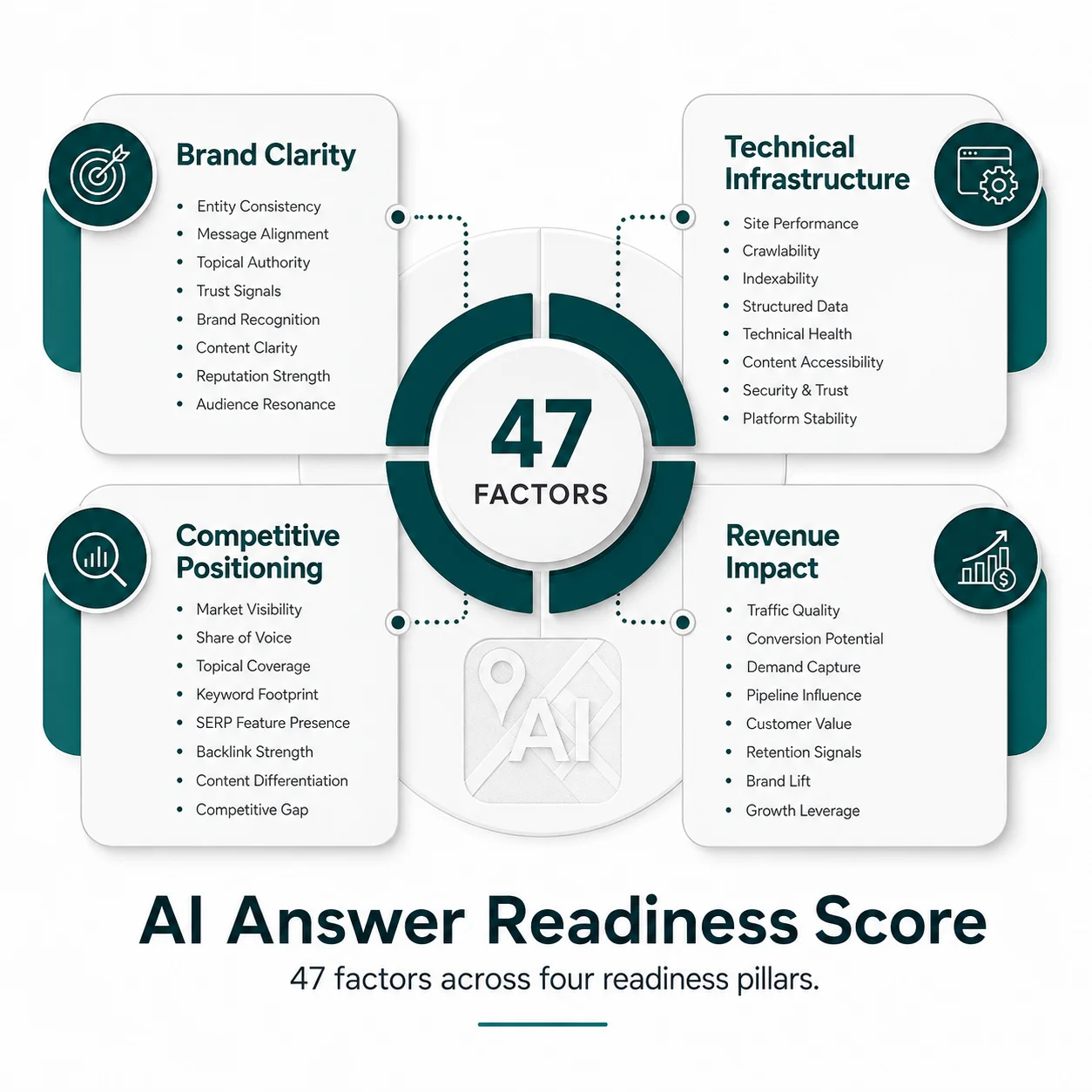
At AI Search Rankings, we utilize the AI Answer Readiness Score (AARS) to provide a quantifiable measure of your business's current state in the AI search market. This proprietary framework evaluates 47 distinct readiness factors across the four core pillars: Brand Clarity, Technical Infrastructure, Competitive Positioning, and Revenue Impact. It offers a detailed diagnostic, pinpointing strengths and weaknesses.
The AARS helps you understand not just where you stand, but precisely what steps are needed to improve your visibility and citation rates within AI systems. It serves as a roadmap for your AEO sprint and ongoing monitoring, ensuring that every optimization effort is strategic and measurable. Understanding your AARS is the first step in converting AI search interactions into tangible business growth.
Overcoming Obstacles
Common Challenges in AEO and How to Overcome Them
Navigating AEO involves specific challenges, but with targeted strategies, businesses can effectively address them to improve AI visibility.
Challenges to Consider
- Content silos and inconsistencies hinder AI from forming a unified understanding of your business.
- Lack of robust, accurate structured data means AI struggles to identify key facts about your services or products.
- Low E-E-A-T signals prevent AI from trusting and citing your content as an authoritative source.
- Outdated technical infrastructure or slow site speed can make your content inaccessible or difficult for AI crawlers to process.
Effective Solutions
- Implement a unified content strategy that ensures consistency across all platforms and clearly defines your brand's offerings.
- Invest in comprehensive schema markup implementation, validating all structured data to ensure AI systems accurately interpret your content.
- Actively build E-E-A-T through expert authorship, verifiable data, client testimonials, and clear
Mistakes To Avoid
Common Mistakes To Avoid
This section outlines frequent errors businesses make when adapting to AI search and how to correct them.
Many marketing directors apply traditional search tactics to AI platforms, which often backfires. Avoiding these specific missteps will help your content surface as a direct answer rather than a buried link.
Stuffing content with traditional keywords.
Marketing teams often repeat exact search phrases throughout a page to signal relevance. They write for legacy crawlers instead of answering the specific questions a user asks.
What it costs: AI models ignore the page because it lacks semantic depth and clear, factual answers.
The correction: Write natural, complete sentences that directly answer specific questions using clear definitions and related concepts.
Burying the direct answer at the bottom of a page.
Content creators frequently write long introductions and background information before getting to the main point. They force the reader to scroll to find the actual answer.
What it costs: AI extraction tools fail to find the answer quickly, so they cite a competitor who provided a direct response at the top.
The correction: Place a concise, definitive answer in the first paragraph, then use the rest of the page to provide context and proof.
Publishing content without schema markup.
Businesses often publish well-written articles but leave the HTML plain. They assume the text alone is enough for an AI to understand the relationships between their brand, services, and locations.
What it costs: The AI system struggles to validate the facts, reducing the chance that the business appears as a recommended entity.
The correction: Implement valid JSON-LD schema markup to explicitly define your organization, services, and factual claims.
Relying on marketing fluff instead of factual statements.
Writers frequently use subjective adjectives and promotional claims to describe a product. They prioritize persuasive copy over verifiable facts.
What it costs: Large language models cannot verify subjective claims, so they exclude the brand from objective summaries.
The correction: Replace promotional adjectives with specific, verifiable data points, clear features, and objective outcomes.
Focusing only on your own website.
Companies often optimize their own domain while ignoring how their brand is discussed on external platforms. They forget that AI models train on the entire web.
What it costs: The AI finds conflicting information or a lack of corroborating evidence, which lowers your brand trust signals.
The correction: Ensure your business information is accurate and consistent across industry directories, review sites, and partner platforms.
Correcting these errors shifts your strategy from chasing clicks to providing the definitive answers that AI systems require.
Your Next Step
What To Do Next
Take these specific actions to move from understanding Answer Engine Optimization to actively securing your position as a cited AI answer. The next step is set out below, along with what happens after you take it.
Request your Free AI Visibility Audit
What you receive: You receive a complete diagnostic report showing exactly where AI search engines currently find, trust, or ignore your business.Submit your website to our system so we can evaluate your current baseline across ChatGPT, Google AI Overviews, and Google Gemini. We measure your site against the 47 readiness factors of the AI Answer Readiness Score.
Schedule a Strategy Session
What you receive: You receive a clear, prioritized roadmap detailing the exact fixes required to make your content extractable and credible for AI models.Meet with our Answer Engine Optimization team to review your audit results and identify the most urgent technical gaps. We map out a specific plan to improve your Brand Clarity, Technical Infrastructure, Competitive Positioning, and Revenue Impact.
Launch a 90-Day AEO Sprint
What you receive: You receive monthly monitoring reports that track your AI answer performance and demonstrate your growing authority as a cited source.Authorize our team to execute the Local Answer System on your behalf. We find your baseline, fix foundational technical issues, structure your content for AI comprehension, and prove your expertise to the language models.
Start hereSelect the action below to begin. You will receive a written assessment of where your business currently appears in AI search, and the specific corrections that would change it.
Verify Your AI Search Visibility
Discover how your brand is cited and recommended across ChatGPT, Google AI Overviews, and Gemini with our free site-level audit.
Get Free AI Visibility Audit