Online shoppers use conversational queries more often. AI search engines like Google AI Overviews and ChatGPT answer these questions by understanding entities, not just keywords. For ecommerce businesses, adapting to entity-based SEO means making your products, categories, and brand facts machine-readable.
This guide explains entity-based SEO specifically for online stores. You will learn how to structure your product data and content so AI understands exactly what you sell. This helps AI systems recommend your business as the best answer to complex shopper inquiries.
Key Takeaways
- Entity-based SEO helps AI search engines understand your ecommerce products and brand by focusing on structured data and conceptual relationships.
- Optimizing for entities improves product discoverability and increases the likelihood of your store being cited in AI-generated answers.
- Ecommerce sites must move beyond traditional keyword stuffing to build a comprehensive knowledge graph about their offerings.
- A robust entity strategy includes rich product descriptions, clear category hierarchies, and consistent brand information across all digital touchpoints.
Foundational Concepts
What is Entity-Based SEO for Ecommerce?
Entity-based SEO for ecommerce optimizes online stores to align with how AI search engines understand information conceptually, moving past simple keyword matching.
Entity-based SEO for ecommerce shifts your optimization focus from isolated keywords to real-world "entities." An entity is a distinct thing or concept: a specific product, a brand, a color, a material, a person, or a place. For an online store, this means ensuring search engines understand your product "Apple iPhone 15 Pro Max" as a specific smartphone model, distinct from "Apple" as a company or "iPhone" as a product line.
AI search engines build knowledge graphs that map relationships between these entities. When a shopper asks, "What are the best noise-canceling headphones for travel?", an AI system does not just look for pages with those exact keywords. It seeks pages that comprehensively describe "noise-canceling headphones" as an entity, link it to related entities like "travel" and "audio equipment brands," and explain attributes such as "battery life" or "comfort."

- Knowledge Block: Semantic Entities in Ecommerce
- Semantic entities are distinct real-world objects, concepts, or ideas that AI search engines recognize and understand within their knowledge graphs. For ecommerce, these include specific products, product categories, brands, attributes (like color, size, material), and even customer intent. Optimizing for these entities means providing structured, comprehensive data that clearly defines your offerings, allowing AI to make more accurate connections and recommendations to shoppers.
Impact and Outcomes
Why Entity SEO Matters for Online Stores
Focusing on entities helps your ecommerce business achieve better visibility in modern AI search, leading to more qualified traffic and sales.
Improved AI Visibility
AI Overviews, ChatGPT, and other AI systems cite information from pages they fully understand. Entity optimization makes your products and services clearer to AI, increasing the chance of citation and recommendation.
Enhanced Product Discoverability
When shoppers use complex, conversational queries, entity-rich content helps AI match their intent with your exact products. This goes beyond simple keyword matching and delivers more relevant search results.
Better User Experience
By providing comprehensive and structured product information, you create a more informative experience for users. This reduces bounce rates and encourages deeper engagement, which AI systems notice and reward.
Stronger Brand Authority
When your brand consistently provides accurate, detailed information about its niche, AI systems recognize you as an authority. This builds trust and positions your store as a go-to source in your industry.
Higher Conversion Rates
Traffic from entity-optimized queries is often highly qualified. Shoppers arrive with a clear understanding of what they need, and your content directly matches that need, leading to increased purchases.
Future-Proofing Your Store
AI search is the future. Investing in entity SEO now prepares your ecommerce business for changes in search engines and ensures long-term relevance and competitive advantage.
Knowledge Block: Semantic Search Impact
Semantic search focuses on the meaning behind queries rather than just keywords. For ecommerce, this means AI understands a shopper's intent, context, and the relationships between various entities. Your product pages must provide rich semantic data to satisfy these complex queries, allowing AI to connect a user's need directly to your specific offerings and attributes.
Strategic Comparison
Traditional Keywords vs. Entity-Based SEO for Ecommerce
| Aspect | Traditional Keyword SEO | Entity-Based SEO (Recommended) |
|---|---|---|
| Primary Focus | Matching exact search terms and phrases. | Understanding concepts, relationships, and user intent. |
| Content Strategy | Keyword density, exact match keywords in titles and body. | Comprehensive information, structured data, semantic relevance, topic authority. |
| AI Search Impact | Limited ability for AI to fully comprehend and cite content. | High relevance and citability in AI Overviews and conversational AI responses. |
| Data Presentation | Text-heavy pages, often unstructured. | Structured data (Schema.org), knowledge graphs, clear entity attributes. |
| Search Query Handling | Struggles with complex, natural language, and implied meaning. | Excels with nuanced, conversational, and multi-faceted shopper queries. |
| Goal for Ecommerce | Drive traffic for specific keywords, often broad. | Increase highly qualified, intent-driven traffic and direct product recommendations. |
AI Interpretation
How AI Search Engines Understand Ecommerce Entities
AI systems use advanced techniques like knowledge graphs and natural language processing to understand the relationships and attributes of your ecommerce entities.
AI search engines do not just read text; they process and interpret meaning. They build vast knowledge graphs where entities are nodes and the relationships between them are edges. For example, your product "organic cotton t-shirt" is an entity. It relates to "organic cotton" (material entity), "t-shirt" (garment category entity), your "brand name" (brand entity), and "sustainable fashion" (concept entity).
This deep understanding allows AI to answer highly specific questions like, "What are the environmental benefits of buying organic cotton t-shirts from sustainable brands?" It can pull information directly from your product descriptions, category pages, and even your "About Us" section if the data is clear and structured. This semantic comprehension is vital for your ecommerce store to appear in AI Overviews and other generative AI search experiences.

Actionable Steps
Building an Entity-Rich Ecommerce Strategy
Implement these steps to optimize your online store for entities, enhancing its discoverability and authority in AI search results.
-
Identify Core Entities for Your Products
Done when: You have a comprehensive list of all primary and secondary entities associated with your top-selling products and key categories.Begin by mapping out all significant entities related to your products and business. This includes product names, brands, unique product identifiers (SKUs, GTINs), colors, sizes, materials, features, target audience, and use cases. Think broadly about how a customer might describe or categorize your offerings.
-
Implement Structured Data (Schema.org)
Done when: All product pages and key category pages have accurate, valid Schema.org markup for Product, Offer, and related entities, verified with Google's Rich Results Test.Use Schema.org markup to explicitly tell search engines about your entities and their relationships. For ecommerce, this means using Product schema, Offer schema, AggregateRating schema, and potentially specific schemas like Brand or even specialized attributes. This code makes your data machine-readable.
-
Develop Rich, Authoritative Product Content
Done when: Your top 50 product pages feature content that fully answers potential customer questions, including all relevant product attributes and comparative information.Beyond basic descriptions, create content that thoroughly describes each product entity. Include detailed specifications, use cases, benefits, FAQs, and comparisons. Weave in related entities naturally. This provides AI with comprehensive context to understand and recommend your product.
-
Optimize Internal Linking and Site Structure
Done when: Your site architecture forms a clear hierarchy, and internal links use specific, entity-rich anchor text that strengthens thematic connections between pages.Your internal links should reinforce entity relationships. Link from a product page to its category, related products, and brand pages using descriptive anchor text. A clear, logical site structure helps AI discover and connect all your entity-rich pages, building a stronger knowledge graph of your store.
-
Maintain Consistent Brand and Product Information
Done when: Key brand and product details are identical across your website, Google Business Profile, and major ecommerce platforms or directories.Ensure all information about your brand, products, and services is consistent across your website, product feeds, social media profiles, and third-party listings. Discrepancies confuse AI systems and dilute your entity authority. Consistency builds trust and makes your information more reliable for AI citations.
Challenges and Solutions
Common Pitfalls in Ecommerce Entity SEO and How to Avoid Them
Advantages of Entity Focus
- Precise AI understanding of unique product features and benefits leads to more accurate AI recommendations.
- Content becomes more helpful and user-centric, addressing actual shopper questions directly and comprehensively.
- Better alignment with future AI search algorithms and evolving user behaviors, ensuring long-term visibility.
- Stronger overall site authority and relevance as AI recognizes your expertise in specific product niches.
Limitations to Consider
- Reliance on keyword density alone dilutes semantic meaning and fails to satisfy complex AI queries.
- Inconsistent product data across channels confuses AI, preventing it from building a reliable knowledge graph.
- Lack of structured data makes it hard for AI to extract key product attributes and relationships efficiently.
- Thin product descriptions that do not fully explain entities leave AI with insufficient context for recommendation.
Expert Support
Partnering for Entity-Based AEO Success in Ecommerce
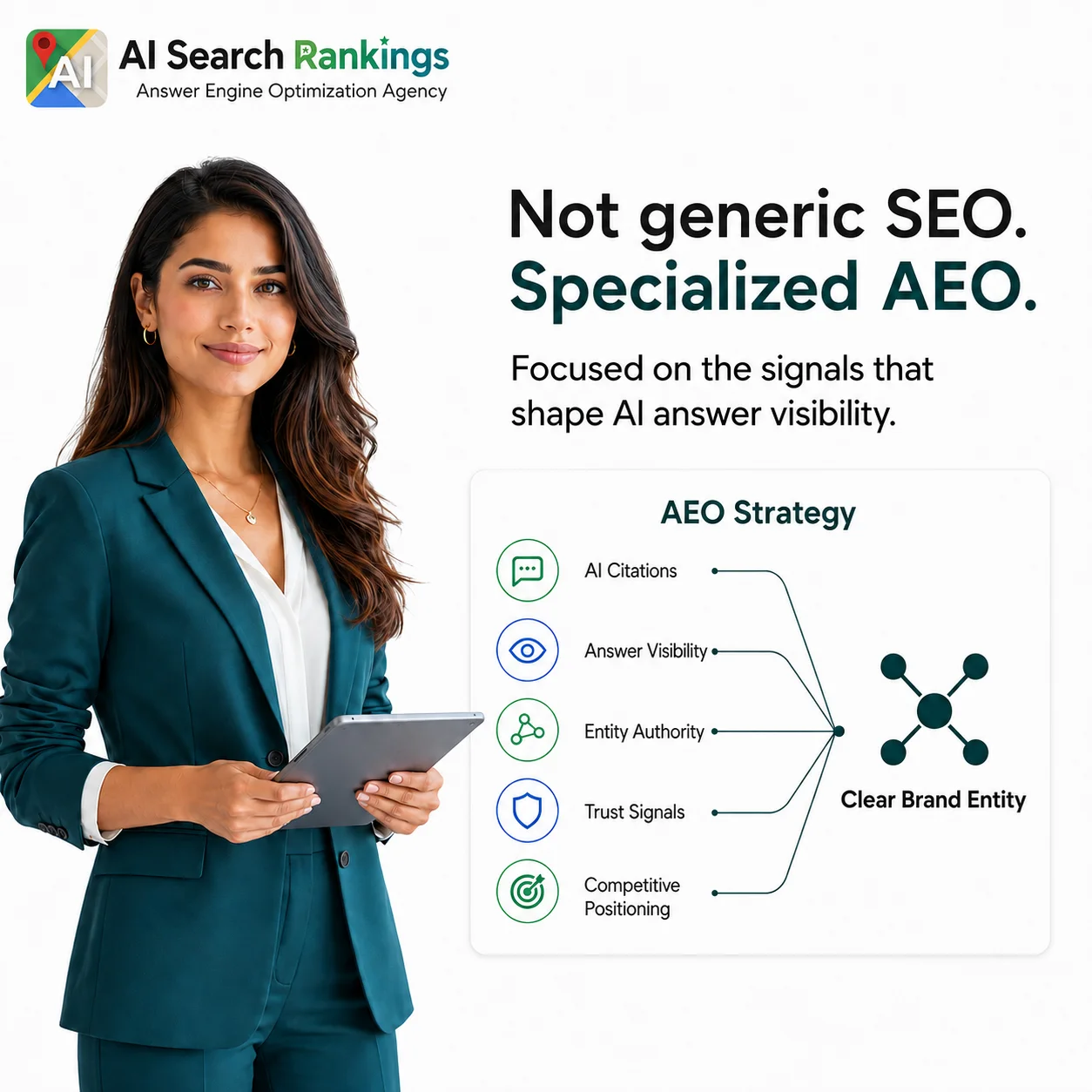
AI Search Rankings provides specialized Answer Engine Optimization services to help ecommerce businesses master entity-based SEO and improve AI visibility.
Navigating the complexities of entity-based SEO for ecommerce requires deep expertise in both semantic search and AI algorithm understanding. AI Search Rankings is an Answer Engine Optimization (AEO) agency that helps businesses become easier for AI search engines to find, understand, trust, cite, and recommend as the answer across ChatGPT, Google AI Overviews, Google Gemini, Google Maps, and search.
Our methodology, including the AI Answer Readiness Score (AARS) and the Local Answer System, ensures your ecommerce store is thoroughly optimized. We analyze 47 readiness factors across Brand Clarity, Technical Infrastructure, Competitive Positioning, and Revenue Impact. Our process helps you structure your product data, enrich your content, and build the authority needed to become the definitive answer for shoppers in AI search.
We offer packages like the Local AI Answer Starter at $799 per month, Local AI Answer Growth at $1,500 per month, and Local AI Answer Authority at $3,500 per month. Each package is designed to provide comprehensive support for your entity-based SEO efforts, from initial audit to ongoing monitoring and growth.
Common Questions
Entity-Based SEO for Ecommerce Frequently Asked Questions
What is an entity in the context of ecommerce SEO?
In ecommerce SEO, an entity is a distinct, well-defined concept or item that AI search engines can identify and understand. Examples include a specific product (e.g., "Sony WH-1000XM5 headphones"), a brand (e.g., "Nike"), a category (e.g., "running shoes"), or an attribute (e.g., "red color", "leather material"). Entities help AI build semantic connections between queries and your product offerings.
How does structured data support entity-based SEO for online stores?
Structured data, primarily Schema.org markup, explicitly tells AI search engines about the entities on your ecommerce site and their relationships. By using Product, Offer, Brand, and other schemas, you provide machine-readable definitions of your products, prices, availability, and attributes. This direct communication helps AI accurately interpret your content and display rich results in search.
Can entity-based SEO help with product comparisons in AI search?
Yes, entity-based SEO significantly improves your products' chances of appearing in AI-powered comparisons. When your product pages clearly define specific attributes (e.g., "battery life," "screen size," "material"), AI can easily extract and compare these features against competing products or user requirements. This makes your products highly discoverable for comparison queries.
Is entity-based SEO replacing traditional keyword SEO for ecommerce?
Entity-based SEO is not replacing keyword SEO but rather expanding and refining it. Keywords remain important as indicators of user intent, but entities provide the deeper semantic context required for AI systems to truly understand and fulfill those intents. A modern ecommerce SEO strategy integrates both, ensuring your content is both keyword-relevant and semantically rich.
Your Next Step
What To Do Next With Entity Based Seo for Ecommerce
This section outlines the exact steps you can take right now to turn your ecommerce store into a recognized entity that AI search engines trust and recommend. The next step is set out below, along with what happens after you take it.
Moving from traditional keyword optimization to an entity-based strategy requires a clear baseline. The following sequence shows how we measure your current AI visibility and build a structured plan to improve it.
Request a Free AI Visibility Audit
What you receive: You receive a scheduled date for your Strategy Session and confirmation that our team is processing your audit.Submit your ecommerce website URL to our team for a comprehensive evaluation. We analyze your current structured data, product entity definitions, and brand clarity across AI search engines like Google AI Overviews and ChatGPT.
Review your AI Answer Readiness Score
What you receive: You receive a clear, objective measurement of how well AI search engines currently understand your ecommerce entities.Meet with our Lead Answer Engine Optimization Strategist, Jagdeep Singh, to review your audit results. We will walk through your AI Answer Readiness Score, which evaluates 47 specific readiness factors across Brand Clarity, Technical Infrastructure, Competitive Positioning, and Revenue Impact.
Launch a 90-Day AEO Sprint
What you receive: You receive a fully structured ecommerce site with machine-readable product entities and a completed foundational optimization cycle.We implement the Local Answer System to find technical gaps, fix them, and structure your product data. This sprint focuses on defining your core product entities, applying accurate Schema markup, and proving your brand authority to AI engines.
Transition to Monthly Monitoring
What you receive: You receive monthly performance reports detailing your AI search citations and ongoing recommendations for product discoverability.AI search algorithms update frequently, requiring ongoing adjustments to your entity strategy. We track how often your products are cited in AI answers and grow your visibility through continuous monthly monitoring.
Select the action below to begin. You will receive a written assessment of where your business currently appears in AI search, and the specific corrections that would change it.
Taking these steps ensures your online store stops relying solely on traditional keywords and starts building a machine-readable knowledge graph.
Ready to Become the Answer AI Recommends?
Get a complete AI visibility audit and a custom Answer Engine Optimization roadmap built for your business, your market, and your revenue goals.
No contracts. Cancel any time. Results you can verify.
Verify Your AI Search Visibility
Discover how your brand is cited and recommended across ChatGPT, Google AI Overviews, and Gemini with our free site-level audit.
Get Free AI Visibility Audit